

The handbook on health care maintenance and operations
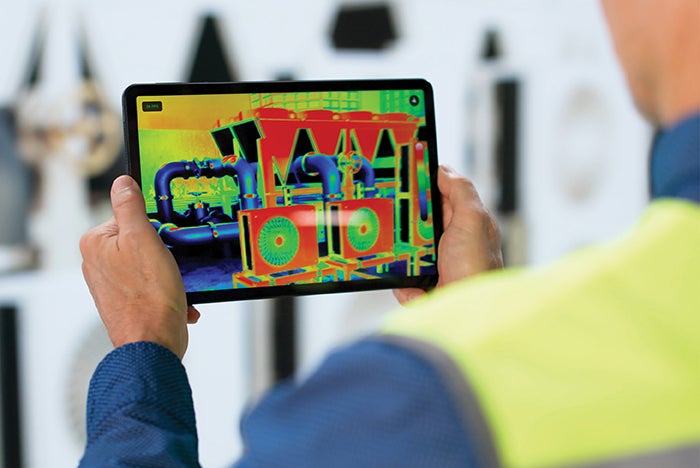
A health care asset management approach to predictive maintenance avoids daily M&O rounds in favor of monitoring critical equipment through tactics such as infrared thermography as well as monitoring sensors; asset condition information; ultrasound testing; and tribology/fluid, vibration and motor analyses.
Image by Getty Images
Maintenance and operations (M&O) is the heartbeat of health care facilities management. Unlike other types of facilities, where an operational breakdown impairs business function, operational failure at a health care facility carries life and death stakes.
Because M&O encompasses the core functions of the facilities department, it requires significant resources and attention from the health care facilities manager. Its mission is to provide a safe environment of healing for patients, visitors and staff; preserve and protect the physical assets of the health care organization; and provide high-quality and cost-effective services.
To help in this mission, the American Society for Health Care Engineering (ASHE) recently published Health Care Maintenance and Operations: The Facilities Management Handbook, from which this article is excerpted and edited. Readers can purchase the complete, 130-page publication at ashe.org/hcfmseries.
The evolution of health care maintenance and operations
Today’s health care facilities are far different from those of even 25 years ago. The technological sophistication of facilities equipment has risen, the regulatory burden continues to increase and there is an ever-growing connection between clinical outcomes and facilities M&O. Finally, effective M&O at a facility is an expectation not just of patients and providers but of payers as well. In fact, the Centers for Medicare & Medicaid Services (CMS) requires hospitals to proactively maintain the facilities environment to receive reimbursement.
Within this already challenging environment, financial margins are shrinking as reimbursement rates fall. Experienced health care facilities managers report increasing difficulty in persuading chief financial officers to add M&O staff; and capital equipment budgets are constrained, requiring aging equipment to be maintained for longer.
This complex environment requires an intentionally planned and managed approach to M&O that is proactive. An increasing number of health care facilities managers have adopted continuous improvement methodologies, such as health care asset management (HCAM).
HCAM is a life cycle-oriented approach designed to help facilities managers improve systems and equipment from commissioning to ongoing M&O through eventual replacement. The goal of HCAM is to improve system uptime and create a predictable workflow.
Daily maintenance and operations work
Health system objectives typically revolve around improving the quality of patient care, enhancing patient outcomes and reducing costs. Daily M&O activities may seem disconnected from these goals, but they align more than one might think because the act of maintaining a health care facility is woven into these goals.
To fulfill a facility’s health care mission, facilities managers and their staff need specific skills and competencies. They must operate within certain standards of performance to carry out department goals and priorities on a timely, accurate and cost-effective basis. And those tasks aren’t limited to a specific campus.
To succeed, facilities managers must gain an understanding of health care facilities M&O, learn how hospital goals relate to their department’s objectives and learn how to manage on-campus and off-site facilities. They also must be able to identify the specific M&O skills and competencies that will help their technicians perform their jobs correctly.
Developing a maintenance and operations strategy
HCAM is built upon the reliability-centered maintenance (RCM) framework and serves as the stage for health care facilities managers to achieve M&O goals.
It allows managers to shift from simple maintenance to life-cycle asset management, using RCM as a core strategy. Skillfully deploying the M&O team based on data collected through an asset management program allows the team to perform maintenance that extends the life of equipment and systems.
Within HCAM, maintenance falls into the following categories:
- Time-directed maintenance (preventive maintenance). Tasks performed at fixed frequencies, such as calendar or clock times.
- Condition-based maintenance (predictive maintenance). Tasks designed to check equipment health by monitoring and trending parameters that indicate equipment health without requiring the equipment to be shut down or disassembled.
- Failure-finding maintenance. Tasks designed to periodically check if important components within an asset have already failed and should be fixed before they contribute to a larger failure. This also is performed without requiring shutdown or disassembly.
- Planned run-to-failure. The intentional decision to use equipment without intervention until it fails. This is done only with equipment that is not needed for critical functions and will not impact safety, create service outages or cause regulatory violations.
- Preventive maintenance repair. This is an important category to document when a repair is identified and completed during one of the maintenance categories discussed here. It is important for facilities staff to take credit for making repairs when its preventive maintenance program and/or staff found a fault during the maintenance.
- Corrective maintenance. An unexpected repair or like-kind replacement that was not anticipated due to a lack of strategy, failed strategy or unperformed preventive maintenance.
Essentially, HCAM is an M&O strategy to improve the reliability of a facility’s systems and equipment through a focus on asset management and preventive maintenance. By identifying the potential operational problems of systems and equipment, HCAM allows managers to proactively decide through continuous improvement how to address those problems before they become a failure.
HCAM encompasses a range of strategies and levels of detail, allowing it to be tailored to the specific needs and criticality of each asset, beginning with a risk assessment of a facility’s systems and equipment based on their criticality.
Underneath the broad umbrella of an asset management strategy are tactics such as monitoring and testing equipment and systems. These tactics provide managers with real-time data they can use to identify trends and issues that could lead to equipment failure. With that data, a manager can select the category of maintenance to schedule and perform.
HCAM provides data-driven insights to justify costly maintenance decisions by comparing them against the potential impacts of system outages. When hospital leaders can clearly see how maintenance activities align with patient safety and care, they are more likely to allocate resources toward work that mitigates risk and supports critical operations. Moreover, when done consistently over time, HCAM results in the gradual reduction of reactive maintenance work.
Reactive maintenance — the break/fix approach to M&O — exists within HCAM only when it is thoughtfully planned as the best economical and safe method for facilities operation. Otherwise, it perpetuates a firefighting approach that lacks scientific evidence.
An asset management strategy converts a health care facility from a cost center to a profit center because it enhances a manager’s ability to lengthen the life of systems and equipment and avoid costly emergency repairs and premature replacements. This translates to an organization that produces more revenue, gets patients in and out of the hospital faster and helps patients maintain their health.
Continuous health care asset management
HCAM is a continuous improvement practice that assesses assets, equipment and systems based on their risk and criticality, determines the most effective and efficient maintenance practices to apply, and documents those assessments and maintenance for analysis. Through this performance improvement loop, a facility is positioned for ongoing enhancement as resources are allocated based on need.
By embedding evidence-based processes into all aspects of M&O, HCAM leads to a significant reduction in daily work orders and scheduled maintenance. Instead, a facilities manager follows a rational planned routine that involves assessing the state of equipment and systems and maintaining and repairing them in an orderly fashion based on the immediate needs of hospital operations.
“Organized maintenance and operational strategies are essential from a reliability, compliance, safety, cost-effectiveness and labor-burden standpoint,” says Ryan Schramm, CHFM, CHC, MECH, FASHE, senior systems manager of facilities operations at Banner Health in Phoenix.
Condition-based monitoring (CBM), a core tactic of HCAM, provides early fault detection for systems, equipment and assets through non-invasive technologies and procedures. CBM provides the opportunity to detect problems while establishing baseline data for comparison and analysis.
CBM optimizes the maintenance cycle to avoid downtime and impact on patient care. CBM also can identify problems that calendar-based preventive maintenance tasks may not detect by pinpointing potential degradation of equipment observed over time.
Building infrastructure and grounds
Once the foundation is laid for optimizing facilities M&O through HCAM strategies and tactics, facilities managers can move into how to manage M&O for health care facilities systems and equipment, including building infrastructure and grounds management, such as roofing, exterior walls and windows; building equipment; utilities; pipes; heating, ventilating and air-conditioning (HVAC) systems; electrical infrastructure; and roadways, parking lots and pathways.
Creating, updating and documenting an asset management program for each of these areas provides a framework for ongoing maintenance.
Asset management involves developing a routine for operating, maintaining and upgrading assets. To maximize a facility’s ability to support the health care organization, facilities managers want to ensure that their staff and systems function efficiently. This means they must be trained and maintained to support the hospital’s mission, vision and values.
HCAM will make this process easier because it helps facilities managers identify and remediate issues before they become expensive problems, all while optimizing the performance and lifespan of each asset within buildings, equipment, grounds and infrastructure.
Each facility asset makes its own contribution to a hospital, and a malfunction in any area could cause a cascade of problems that could negatively impact patient care. Consequently, managers need to understand how these assets contribute to a hospital individually and collectively.
Managing shutdowns is another important function. Planned shutdowns can occur during construction, renovation or maintenance. Unplanned shutdowns can occur during weather events or because of operational problems related to utilities. Whichever the case, facilities managers need to plan for them.
Life safety requirements
Life safety requirements ensure that hospitals provide a reasonable degree of safety for patients and staff during a fire or other emergency. Hospitals must maintain and regularly update life safety plans to ensure the proper integrity of the life safety system and ensure that it can prevent the spread of fire and other emergencies from harming patients and staff.
Life safety systems stand out because of their direct regulatory oversight and frequent inspections by authorities having jurisdiction (AHJs). Facilities managers must handle life safety M&O from a black-and-white perspective — there is a right way to do life safety M&O and a wrong way. This also means that both the facilities department and senior hospital leadership take life safety M&O best practices very seriously.
While every system has the potential to impact patient care, life safety systems operate under clear compliance standards that must be met for the hospital to remain in operation. The clear requirements behind life safety codes mean that when AHJs find violations, they readily cite them.
A facilities manager and staff need to maintain a high level of visibility into the M&O requirements, not only because of requirements from AHJs but also because of the ways that life safety failures can impact the overall facility.
Of course, less-regulated systems can still cause significant disruptions to hospital operations if they fail. These outages may not result in citations, but they carry serious implications for patient services. Evaluating the criticality of these systems requires a more nuanced, subjective decision-making process that goes beyond regulatory mandates.
Electrical systems
As a core element of most assets, facilities managers must understand how their electrical systems are connected and the essential M&O activities required to keep them functioning.
While reliability is the number one priority when it comes to electrical systems, safety also is important. Codes and regulatory requirements from a variety of national and local AHJs, including CMS, complicate the job of maintaining and operating electrical systems.
Because of the critical nature of many hospital electrical systems, facilities managers and their staff must ensure that ongoing preventive maintenance activities are scheduled, monitored and documented to prove that the maintenance was performed, often due to regulatory requirements.
“Maintenance of electrical systems in health care facilities is largely governed by [the National Fire Protection Association’s] NFPA 70® [National Electrical Code®], NFPA 99 [Health Care Facilities Code] and other applicable codes, which prescribe scheduled inspection, testing and preventive maintenance activities. These requirements are typically outlined in an electrical maintenance program,” says Chad Beebe, AIA, CHFM, CFPS, CBO, FASHE, deputy executive director of regulatory affairs at ASHE. “However, recent updates have acknowledged that routine exercising of certain electrical equipment during inspections and testing can sometimes cause unintended wear or damage. In response, regulatory bodies have begun to accept alternative equipment maintenance programs for specific electrical components. These programs allow facilities to tailor maintenance strategies based on equipment history, performance data and risk assessments, providing flexibility while still ensuring safety and compliance.”
HVAC systems
HVAC and refrigeration systems perform critical functions by controlling infections and other illnesses and contributing to patient, staff and visitor comfort. Because of the crucial role of these systems, HVAC and refrigeration standards and codes have been developed by a variety of national, state and local AHJs that require strict compliance, much of which is through a facility’s M&O activities.
Although HVAC and refrigeration systems are made of many separate components, considering those components as an overall system gives facilities managers a leg up in terms of troubleshooting and breakdowns because the components must function as an overall system to fulfill their purpose.
“Hospital ventilation systems are an often overlooked yet vital part of patient care,” Beebe says. “They play a central role in controlling airborne infectious diseases, reducing the need to isolate every patient and helping staff to manage cases more effectively.
“Routine testing and documentation help ensure that these systems continue to function as intended, safeguarding both patients and staff,” Beebe adds.
Creating, following and documenting a ventilation management program also is an important part of HVAC system M&O.
Plumbing and piped systems
Reliable hospital plumbing and piped systems are critical for infection control, patient safety and the prevention of waterborne pathogens. Many systems make up plumbing and piped systems: the steam and hot water generation and distribution systems, the medical gas and vacuum systems, and the domestic and process water and sanitary systems.
Plumbers and building engineers are responsible for maintaining plumbing and piped systems. Depending on the size and complexity of a facility, facilities managers likely require a mix of in-house and outsourced plumbers.
Facilities managers should assess all systems to determine criticality and then decide on the proper maintenance approach. Many local, state and federal AHJs are involved in regulating these systems and will impact how one maintains and operates assets.
Facilities managers need to understand the functions that these systems serve in the hospital and how to maintain them according to relevant codes and HCAM. They also need to ensure that they have skilled and, where necessary, certified technicians performing ongoing maintenance.
Compliance requirements for plumbing and piped systems include having a water management plan to identify, monitor and mitigate the risk of Legionella and other pathogens, and medical gas and vacuum systems, which must be appropriately designed, installed, tested and maintained. All piping must be clearly labeled and color coded, and outlets, valves and alarms also must be clearly identified.
Additionally, hazardous waste must be appropriately handled, contained and disposed.
Maintenance and operations for complex environments
While it is impossible to cover every aspect of M&O, some additional duties include medical equipment installation; laundry, kitchen and food service maintenance; elevator maintenance; and understanding how hospital information technology and security systems affect facilities management.
Facilities managers also are asked by hospital space management committees to advise on and coordinate moves within the facility. Fortunately, an HCAM strategy that has been refined through electrical, plumbing, HVAC and other M&O can be applied to these areas as well.
Health care facilities are far more complex than most other facilities, and their occupants are highly vulnerable and sensitive to their environments.
To address these high stakes, the health care field has adopted concepts from industrial sectors such as nuclear energy and airlines. These best practices, which are aligned with the HCAM approach, help ensure that facilities can safely operate at peak performance.
“Success for [M&O] in a health care environment is optimally creating an environment that is conducive to providing excellent care; is safe for patients, staff and visitors; and that optimizes the health care environment,” concludes Jonathan Flannery, MHSA, CHFM, FASHE, FACHE, senior associate director of regulatory affairs at ASHE.
About the handbook authors
The American Society for Health Care Engineering (ASHE) extends its sincere and heartfelt gratitude to the individuals who offered their time, knowledge and effort in the creation of Health Care Maintenance and Operations: The Facilities Management Handbook.
Lead author
Dave Lockhart, CHFM, CEM, CRL, FASHE, is the executive director for facilities operations and maintenance, National Shared Services Operations, Kaiser Permanente, based in Oakland, Calif.
Contributors
- Chad E. Beebe, AIA, CHFM, CFPS, CBO, FASHE
- Candice Bradley
- Jonathan Flannery, MHSA, CHFM, FASHE, FACHE
- Dennis Ford, MHA, CHFM, CHC, FASHE
- Roy Hirchak, CHFM, SASHE
- Brady Housden, CHFM, CHC, CHOP, FDAI, SASHE
- Devin Hugie, MBA, CHFM, CHC, CRL, FASHE
- Narsimha Irrinki, MS, PE, CHFM, CPE, CPD, SASHE
- Ryan Schramm, CHFM, CHC, MECH, FASHE
- Andy Woommavovah, CHFM, SASHE
Editors
- Chris Dimick
- Corrie Fisher, MEd
ASHE would like to thank Amy Buttell for her writing collaboration and editorial assistance on this publication as well as its partners at Jenkins Group Inc.
This article was excerpted and edited by Health Facilities Management staff from the American Society for Health Care Engineering’s Health Care Maintenance and Operations: The Facilities Management Handbook.
Related Articles

Nuvolo launches regulatory compliance management to tie survey readiness directly to maintenance work
New capability maps regulatory standards to assets so healthcare organizations can build compliance evidence as work gets done.

Optimizing healthcare infrastructure through enterprise asset management
How Montefiore Einstein implemented a single source of truth for building spaces and infrastructure assets.

Security ecosystem helps manage risk
City of Hope partnered with Motorola Solutions to developed a layered security strategy for its 100-acre California campus.