

The cost of poor activation for new projects
The annual Hospital Construction Survey, conducted by the American Society for Health Care Engineering’s Health Facilities Management, is a great channel to explore of-the-moment topics. In 2024, we discussed how inflation, supply chain delays and labor shortages were impacting projects. Our 2026 survey, which will appear in next year’s Spring issue, will cover how security and safety are integrated into the planning, design and construction of health care facilities.
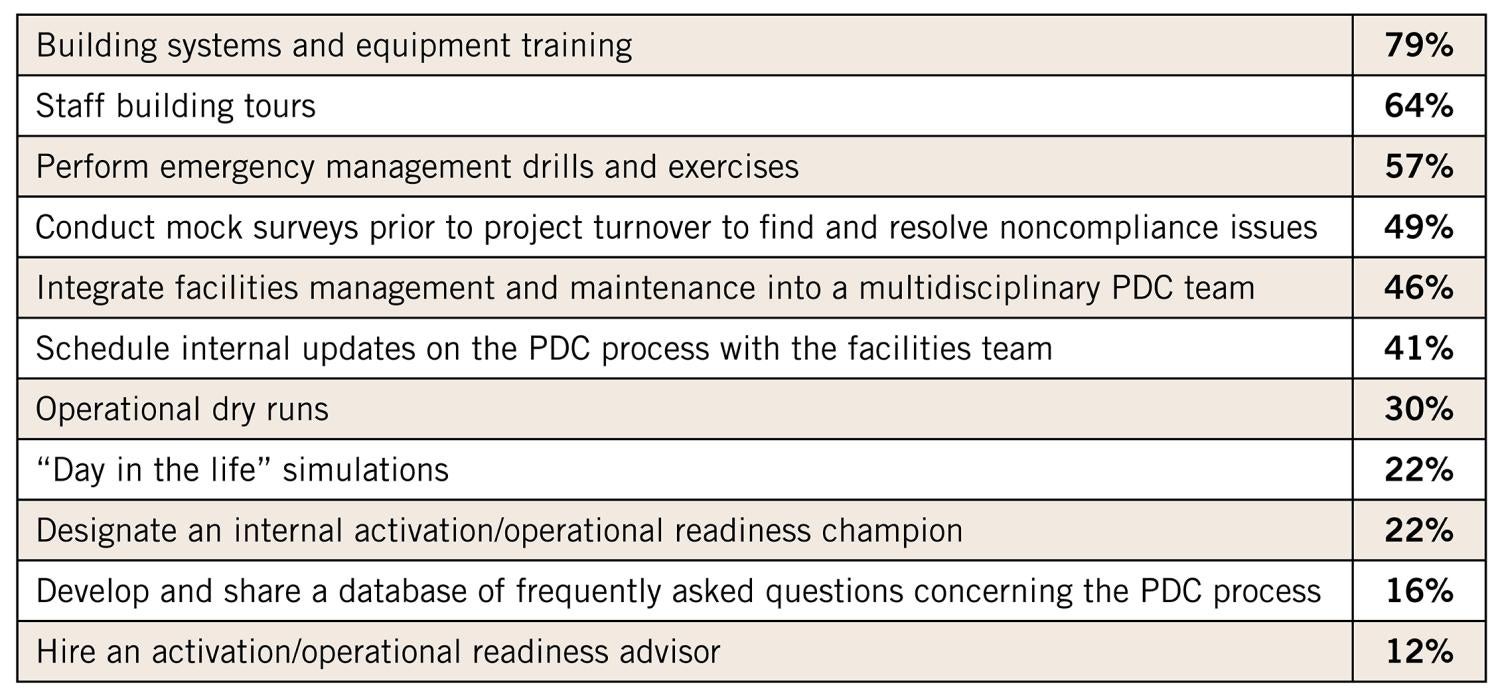
Our 2025 Hospital Construction Survey addressed the strategies employed during design and construction to ensure that, when new facilities launch, they are operational and survey-ready.
Click chart to expand
No matter the survey topic, however, the goal always remains the same: to deliver actionable insights that help professionals do their jobs better. That often comes in the form of using numbers to tell a story, such as sharing the top best practices and revealing major barriers in the field that should be addressed. Numbers are great, but they aren’t the only type of data that paints a story. Anecdotal information also is a credible source of data, shedding light on the outcomes of certain strategies when they are or are not used.
For instance, in our 2025 Hospital Construction Survey, strategies such as designating an internal activation/operational readiness champion (22%) and hiring an activation/operational readiness advisor (12%) ranked fairly low on the list of best practices being used by respondents to ensure operational and survey readiness on Day 1. Purely looking at the numbers, one could draw a few conclusions. Perhaps these strategies rank lower because organizations find them ineffective. But anecdotal information, in which respondents told us about success stories and cautionary tales in Day 1 readiness, reveals something different.
One survey respondent who sought outside help credited this strategy with ensuring staff did not miss a beat when their new facility opened. “A crucial factor was the engagement of a third-party transition planner who was able to identify key players, workflows and the many processes and policies that needed to be considered and were being changed from our current to our new environment.”
Some used in-house champions with great success. “Specific integration of dedicated clinical staff in planning, design and construction throughout the project and additional resources for further operational planning led to a fully successful activation,” one respondent said.
These and several other anecdotes contradict the hypothesis that activation leaders, whether external or internal, rank lower on the list because they are ineffective. What else could it be? Perhaps it’s a resource issue, with staff and dollars stretched too thin to either devote an internal champion or hire outside expertise. It’s understandable. Unfortunately, many anecdotes reveal that those who did not prioritize hiring or designating an activation leader on the front end often paid for it anyway.
One respondent discussed the project delays they endured by not engaging an activation leader earlier. “The team had a good activation plan, including system commissioning, asset tracking, owner training and document transfer. However, the plan was initiated too late, delaying the opening by 30 days,” they said.
The lack of an activation leader can also result in operational issues. “One day prior to the move, it was discovered that none of the heating, ventilating and air-conditioning alarms or trending [settings] were set up in our building automation system. We had to have crews work overnight to test and recommission,” one respondent shared.
These stories provide a greater insight than what the numbers show by themselves. Although the uptake in hiring or designating an activation leader for construction projects is low, the impact of having or not having one can be significant, for better or worse.
About this column
“Data Insights” dissects information collected through the American Society for Health Care Engineering’s Hospital Operations, Hospital Construction and Salary surveys. It pulls from original research to discuss nuanced issues affecting health care facilities professionals across the United States.
Related Articles

NFPA weekly update: Sept. 14-18
A tentative interim amendment on weapons detection systems was added to NFPA 5000, Building Construction and Safety Code.

The facilities manager’s role in reducing healthcare-associated infections
From multidisciplinary communication to establishing safety procedures for construction, remediation and maintenance, facilities teams play a critical hand in reducing patient infections.

AdventHealth expands in Tampa Bay with new patient tower
Expected to open in 2029, the new six-story patient tower at AdventHealth Carrollwood will expand inpatient and surgical services for the rapidly growing area.