

Health system invests millions in high-tech beds
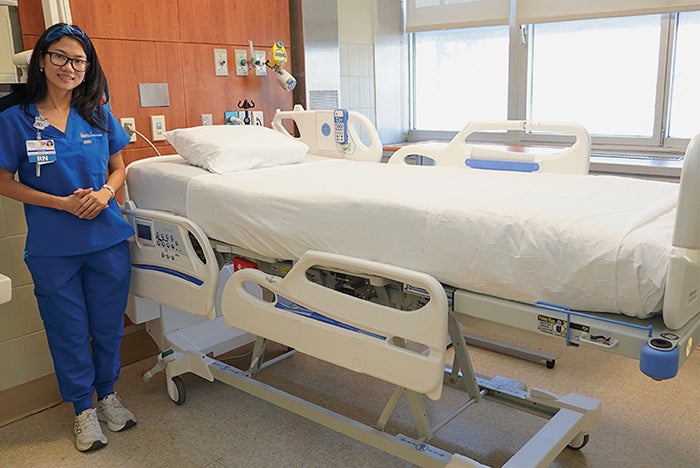
Nurse Mandie Xie shows off one of the new Hillrom Centrella smart beds recently installed in the medical-surgical units at NYC Health + Hospitals/Harlem.
Image courtesy of NYC Health + Hospitals
NYC Health + Hospitals in New York City has invested $30.5 million to outfit medical-surgical units across its health care facilities with 2,000 new high-tech hospital beds. These new beds are expected to improve the patient experience, enhance patient quality outcomes and support nursing staff.
The beds can prevent falls with alarms and audio messages as well as images indicating various safety settings that are projected onto the floor for easy staff visibility. New beds in the hospitals’ intensive care units can adjust into a seated position to help patients get out of bed and reduce strain on nurses. Vibration and rotation therapy settings can loosen fluid in a patient’s lungs while they lay in bed. Beds in all units include features to reduce the risk of bed sores for immobile patients. More specifically, the beds can automatically turn patients, and mattresses can circulate air pressure, heat and moisture.
The beds offer advantages to clinical staff. “The new beds are good. The alarms are louder, and the bed speaks in English and Spanish,” says Maita Ramos, R.N., a nurse at NYC Health + Hospitals/Lincoln. “The patients comment that they like the charging ports for their cell phones.”
NYC Health + Hospitals worked with Chicago-based medical equipment supplier Hillrom to standardize the beds throughout the health care system and facilitate easier information technology integration with the nurse call system, which also is being upgraded and will pave the way for integration with its electronic health record.
“These new beds represent the future of hospital care,” says Danielle DiBari, Pharm.D., senior vice president of business operations, chief pharmacy officer and chief procurement officer at NYC Health + Hospitals. “Bed sores and falls are two of the key challenges our care providers face during prolonged hospitalizations, so to be able to protect our patients from those risks will be a huge step forward. And from a simple comfort perspective, offering an easily accessible place our patients can plug in their phones and stay connected to loved ones makes a huge difference.”
NYC Health + Hospitals’ supply chain department oversees a $2.5 billion portfolio to procure everything the health care system needs to serve more than 1 million patients a year.
Related Articles

Agencies issue eight principles for OT cybersecurity
U.S. and international agencies released eight principles to eliminate cyber vulnerabilities in operational technology.

NFPA report reviews risks associated with smart buildings
The NFPA's Fire Protection Research Foundation report dissects the impact of smart building technology on life safety and presents a roadmap to address its challenges.
Hospitals pilot virtual reality training for infection prevention
Massachusetts hospitals explore the potential of emerging technologies to better teach cleaning and disinfection protocols..