

Designing pediatric facilities for regulation and resilience
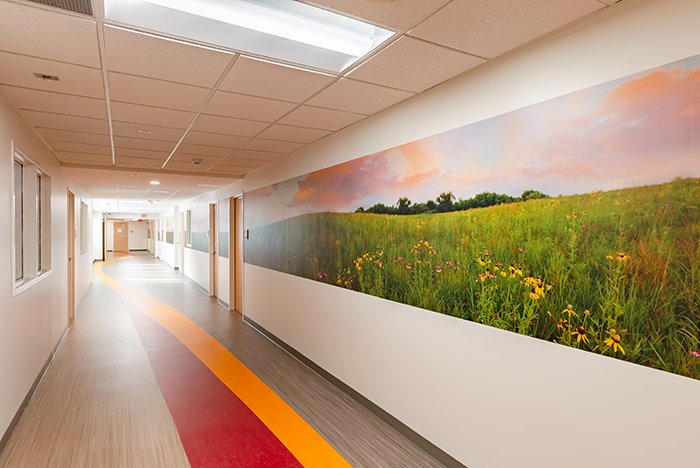
Allina Health uses color in a purposeful way to help with visual cues.
Image courtesy of Wold Architects & Engineers
Schools and pediatric health care settings share a key mission: to create inclusive spaces that promote children’s healing, learning and growth. Both environments shape how a child regulates emotions and experiences autonomy. Over the past decade, K-12 design has increasingly centered on flexible environments that anticipate diverse needs. Pediatric facilities can learn from this shift. Rather than designing for a narrow clinical moment, health care environments can adopt a normative design lens — one that assumes variability in emotional regulation, sensory processing and social interaction as the baseline, not the exception.
The lived experience of pediatric health care environments plays a defining role in a child’s healing and development. Every clinic, therapy room and waiting area shapes how young patients experience care and build trust with their care team. This is where trauma-informed, or normative, design becomes essential. It moves beyond accommodation and toward environmental strategies that proactively support regulation, predictability and dignity for all children.
From accommodation to normalization
When children seek health care, it’s crucial to remember that their needs go beyond the demands of their present condition. Design approaches should center on the understanding that every pediatric patient walks into the clinic with a wealth of individual experiences and “presets” that may not be immediately apparent but significantly affect how they navigate a space. They may grapple with invisible challenges like sensory sensitivities, anxiety disorders, attention-deficit/hyperactivity disorder, autism spectrum disorder, learning differences or mental health challenges. The task of a designer is to shift from reactive accommodation to anticipatory planning. Rather than asking how to adapt a space for specific needs or diagnoses, the better question is, how can designers normalize a broad range of sensory and emotional responses within the physical environment?
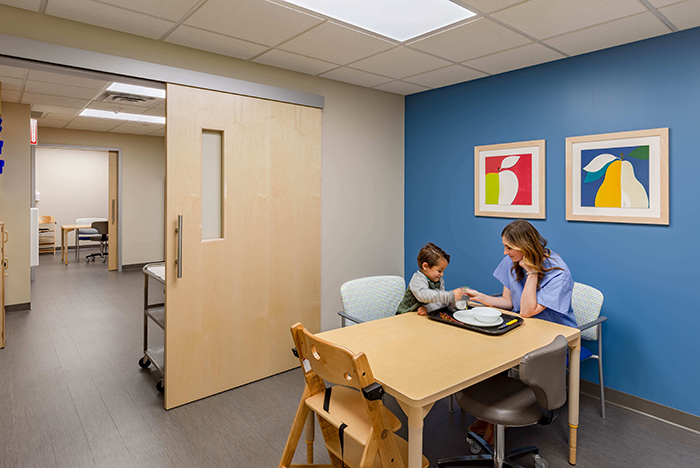
Designs should incorporate a variety of spaces to accommodate patients with diverse processing styles.
Image courtesy of Wold Architects & Engineers
This is where insights from contemporary K-12 environments are instructive. Classrooms increasingly incorporate quiet corners, variable seating, visual schedules and controlled sensory input. These are not labeled as accommodations but as good design. Pediatric facilities can apply the same principle by assuming diversity in processing styles and designing accordingly.
Designing to create predictability
Invisible needs for different ways of processing stimuli rarely trigger code-based design requirements. Lighting levels, acoustics, corridor widths and material selections may comply with accessibility standards but still overwhelm children with sensory sensitivities. Normative design addresses how environments shape and respond to stress and prior adverse experiences. It is grounded in several core principles: safety, predictability, choice, collaboration and empowerment.
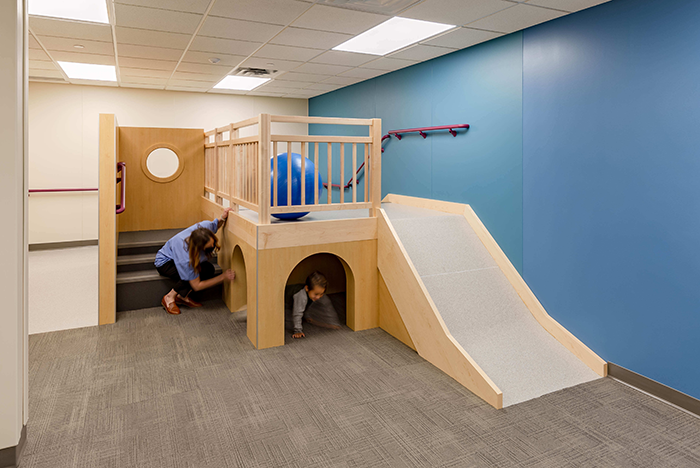
Warm materials and layered lighting help to reduce stress.
Image courtesy of Wold Architects & Engineers
In practice, this means shaping environments that reduce threat cues, clarify spatial expectations and allow children appropriate control. In health care settings, stress responses are common. A clinical visit can elevate heart rate or trigger fear or pain based on recall of prior negative experiences. Normative design doesn’t eliminate those realities, but it mitigates unnecessary environmental stressors that compound them. Key challenges to solve for include:
- Institutional aesthetics that unintentionally signal authority or loss of control/individual autonomy;
- Circulation paths that create confusion or expose children to overstimulating traffic;
- Spaces that force passive waiting without opportunities for self-regulation; and
- Examination rooms that prioritize equipment over comfort.
Normative design reframes the way we can approach these challenges. Designing with empathy, dignity and inclusivity is critical to supporting children with both visible and invisible needs. Rather than designing for a child “in crisis,” it assumes that any child may experience stress and builds an environment that supports regulation at every touchpoint. This can include:
- Clear sightlines that create intuitive wayfinding and reduce uncertainty;
- Layered lighting that creates gentle transitions between public and private zones;
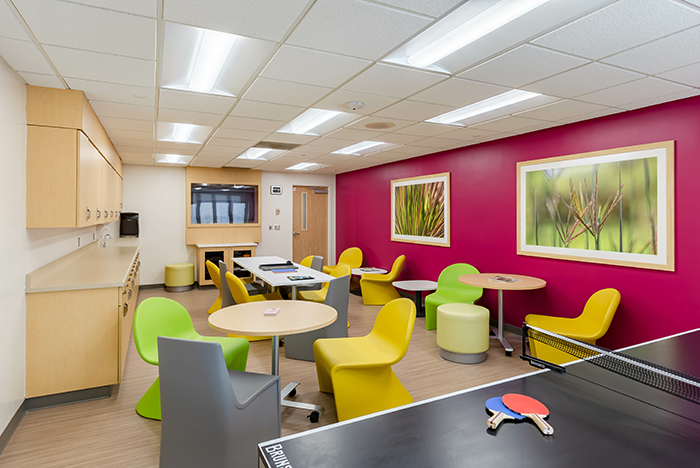
- Warm, residential materials that soften clinical appearance; and
- Flexible rooms that accommodate various therapeutic modalities without disorientation.
Caption goes here
Image courtesy of Wold Architects & Engineers
In K-12 environments, similar strategies appear in sensory rooms, small-group breakout areas and transparent circulation patterns. The lesson for pediatric design is not to replicate schools but to embrace the cross-sector lesson that predictability builds safety, and safety builds engagement.
Normative design in action
Real-world examples illustrate how normative design moves beyond theory, lending to health care the education design principles that create flexible, supportive environments that empower every child to thrive.
The Allina Health United Hospital Outpatient and Inpatient Mental Health facility in St. Paul, Minn., integrates nature-inspired materials, generous daylighting and clear circulation paths to reduce stress and promote emotional regulation and comfort. The design emphasizes openness without sacrificing privacy to help patients remain oriented while feeling protected at all stages of care.
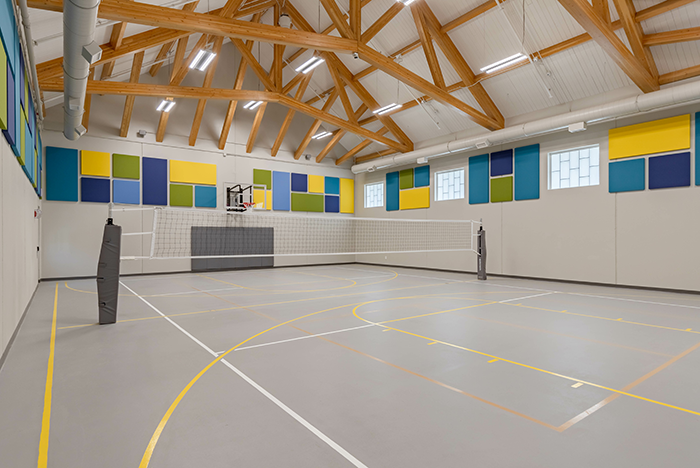
Gyms and multipurpose areas provide active zones to accommodate movement-based therapy.
Image courtesy of Wold Architects & Engineers
Allina’s pediatric therapy facilities apply sensory-supportive strategies through soft textures, engaging visual cues and purposeful color use. These environments support therapists in guiding children through regulation activities while building trust and familiarity.
The Child and Adolescent Behavioral Health Hospital in Willmar, Minn., incorporates flexible, trauma-informed spaces that adapt to varying therapeutic intensities. Gymnasiums and multipurpose areas allow movement-based therapy, while quieter support rooms offer decompression options, supporting a spectrum of regulation needs within a cohesive environment.
Across these projects, several best practices emerge:
- Colocation of services to reduce disruptive transitions;
- Clear zoning between active and restorative spaces;
- Environmental cues that support sequencing and orientation;
- Material choices that balance durability with warmth; and
- Design processes that involve clinicians, caregivers and youth voices early.
Empathy at the center of design
Pediatric facilities are clinical settings, but they’re also formative environments that shape a child’s sense of agency, safety and trust. By integrating lessons from K-12 design and embracing normative principles, pediatric health care environments can graduate beyond simple spaces that meet compliance and accommodation standards. They can create spaces that anticipate variability and actively support regulation for a smoother patient experience.
When design assumes diversity rather than exception, invisible needs are no longer marginalized. They are simply part of the human spectrum that the environment is built to support. In this way, normative design isn’t an overlay. It’s a core philosophy recognizing that each child arrives with a unique story, and the physical environment can either amplify stress or foster resilience.
Andrew Jordan is a health care practice leader at Wold Architects & Engineers. He can be reached on LinkedIn.
Related Articles
Making sense of health care sensory rooms
Research compiled in The Center for Health Design's Knowledge Repository documents outcomes related to multisensory care spaces.

Integrating robotics into inpatient facilities
Optimizing the design and layout of healthcare spaces to integrate autonomous mobile robots into daily operations.
Transforming facilities from retail to healthcare
Innovative architecture strategies to help developers and healthcare owners unlock the future of underperforming real estate.