

3D-printed models help visualize design changes
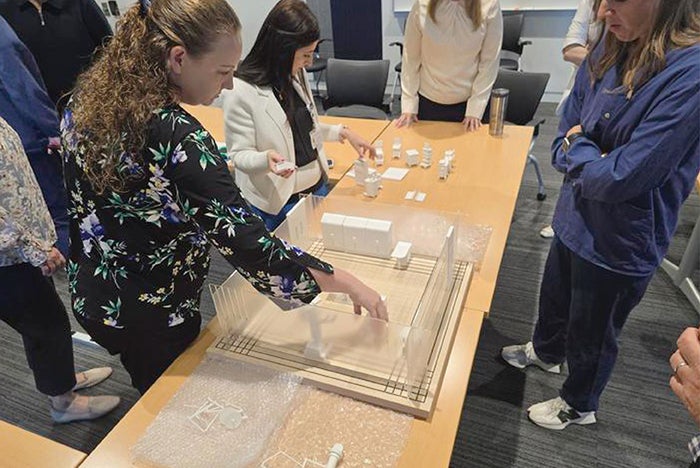
Tangible pieces allowed surgeons, anesthesiologists, OR techs and other vested stakeholders to physically interact with the layout and test real-world scenarios.
Image courtesy of University of Kentucky
The University of Kentucky Albert B. Chandler Hospital in Lexington, Ky., is relying on 3D-printed, to-scale models of hospital equipment and furniture to refine the layout of new operating rooms (ORs). The new ORs are part of a larger hospital expansion project.
The models are being used to come up with equipment placement layouts to ultimately ensure optimal workflows. The 3D-printed models of surgical equipment, operating tables and medical furnishings offer a cost-effective alternative to higher-cost, full-scale mock-ups, enabling surgeons, anesthesiologists, OR techs and others to physically interact with the layout and test real-world scenarios.
“It’s easier to have tangible pieces to work out workflows, traffic in the room, power and data,” says Angela Walton, capital construction senior manager at the University of Kentucky. “This collaborative team approach gives you much better input from all users.”
The expansion uses 15,000 square feet of shelled space adjacent to the hospital’s existing ORs and pre-op/post-op rooms. The project will add up to eight additional ORs and associated support spaces.
The hospital expansion, which is scheduled for completion in 2029, also includes inpatient rooms; observation spaces; rooms for minor procedures; diagnostic, imaging, pharmacy and laboratory services; support areas; and meeting spaces.
Related Articles
Making sense of health care sensory rooms
Research compiled in The Center for Health Design's Knowledge Repository documents outcomes related to multisensory care spaces.
Integrating robotics into inpatient facilities
Optimizing the design and layout of healthcare spaces to integrate autonomous mobile robots into daily operations.
Transforming facilities from retail to healthcare
Innovative architecture strategies to help developers and healthcare owners unlock the future of underperforming real estate.