

Improving resiliency in the face of crisis
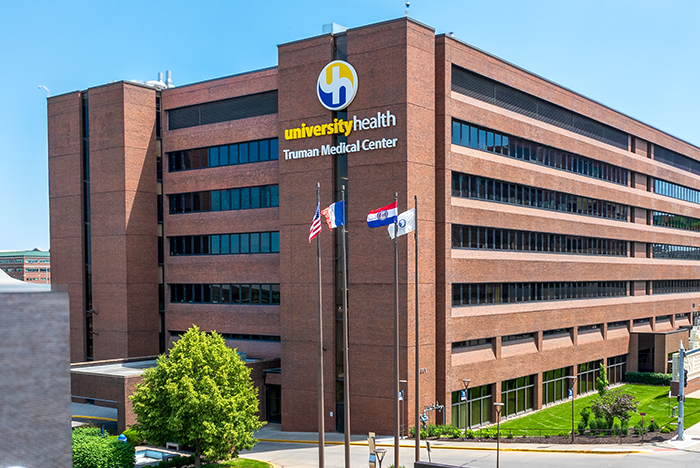
After assessing both its infrastructure resiliency and energy efficiency, University Health Truman Medical Center buckled down to improve its performance in both categories with an overhaul of its power plant.
Image credit: John Williams, University Health Public Relations
Many facilities and safety professionals who manage accreditation documentation probably consider the annual hazard vulnerability analysis review as a necessary chore for accreditation compliance. In addition, since the early 2010’s, many large and medium-sized municipalities have required building owners within their jurisdictions to provide energy usage data through the Environmental Protection Agency (EPA) ENERGY STAR® Portfolio Manager depending on the size of their buildings, adding another monthly chore to already full plates. But what if the field stopped seeing these tasks as chores but rather tools that, when combined, effect positive operational and safety change to their organization?
Managing risk and energy
Located in the University of Missouri-Kansas City (UMKC) Health Sciences District, 1 mile south of downtown, University Health Truman Medical Center is the city’s essential, safety-net hospital. Officially dedicated in 1976 as a replacement facility to the original Kansas City General Hospital, the Joint Commission-accredited, 264-bed medical center has served as Kansas City’s Level I trauma center and safety net for 50 years, employing a dedicated team of more than 2,500 front-line and support professionals. It is also an academic teaching hospital affiliated with the UMKC School of Medicine directly attached to the hospital, educating the doctors and nurses of tomorrow.
Supporting the new University Health Truman was an original off-site 1923-built central power plant, which provided high-pressure steam from three natural gas-fired 45,000-horsepower boilers through steam lines running through shallow tunnels beneath two busy city streets to the main hospital. The power plant also originally served as the main laundry facility and medical waste incinerator until the early 1970s. The hospital was heavily dependent on its steam supply to provide heat, hot water, sterilization, humidification and low-pressure steam to operate three absorption chillers manufactured by York for building cooling, which were augmented by two electric centrifugal chillers manufactured by Trane.

To improve operating costs, University Health Truman executive leadership entered into a 12-year agreement with a local utility company in 2006 to provide district high-pressure steam to the main hospital. This allowed leadership to reduce power plant personnel from nine full-time equivalents (FTEs) to three. The remaining FTEs maintained the power plant boilers in a ready-state in case the district steam supply was ever disrupted.
In 2012, the University Health Truman facilities team began to notice significant road salt deterioration and delamination of the concrete steam tunnel walls from the city streets above. In addition, a local utility company boring new fiber-optic cable lines around the campus penetrated the main steam tunnel. The drill came in contact with the main steam line, damaging pipe insulation. This near-disaster heightened the facilities team’s concerns of potential tunnel failure resulting in catastrophic loss of main district steam supply. Facilities leadership documented steam supply failure as a “high risk” on its Joint Commission hazard vulnerability analysis (HVA). The HVA results initiated facilities team discussions with executive leadership and local mechanical engineering firms to begin planning for a dedicated power plant to be located on the University Health Truman hospital property.
Simultaneously, facilities management implemented use of the ENERGY STAR Portfolio Manager and began collecting utility use data for the main hospital and several of campus medical office buildings. The facilities team also began sharing main hospital ENERGY STAR data with the American Society for Health Care Engineering’s Energy to Care® Dashboard. Collecting utility invoice data back to 2010, the team established a baseline energy performance score for each campus building and achieved an unofficial ENERGY STAR rating.
The initial result was indeed disappointing as the hospital scored a 7 out of 100. Analyzing the performance data, the team recognized that University Health Truman’s heavy dependence on steam was an inefficient primary energy source, significantly contributing to the low energy-use performance score. As a result, facilities leadership began brainstorming opportunities to eliminate the identified risk of steam system failure from the HVA and improve energy efficiency and performance, with the ultimate goal of a power plant replacement project. The facilities leadership team had several proposals to replace the main power plant with an on-site, natural gas-powered steam plant to coincide with the termination of the district steam contract. However, by 2018, capital funding was not available to move forward. Then along came COVID-19.
Powering the project forward
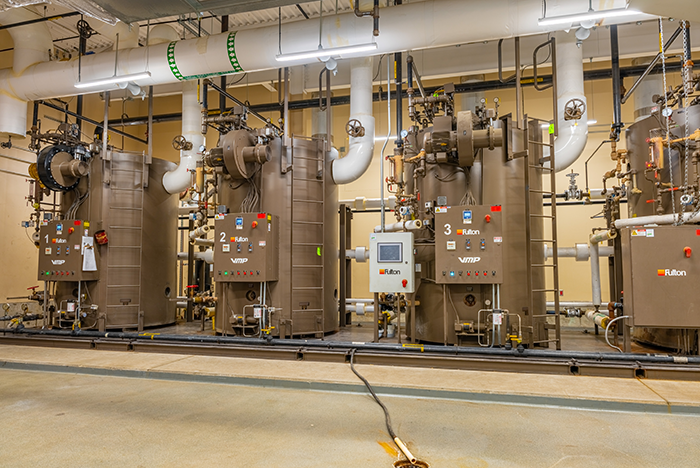
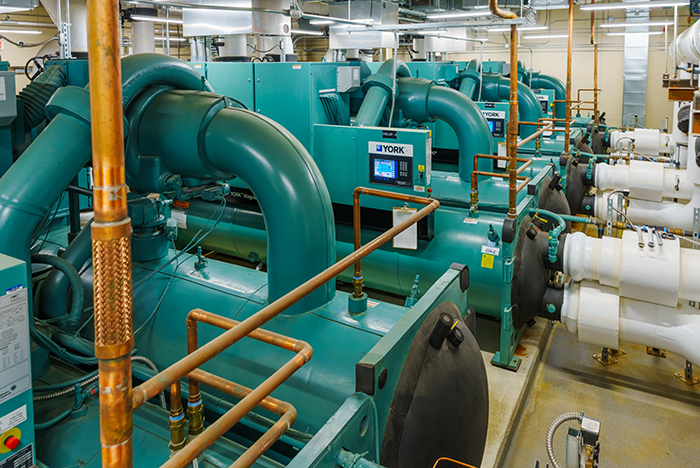
Top: The project included a new boiler penthouse to supply high-pressure steam. Bottom: The chiller penthouse consists of four new chillers to serve the facility.
Image credit: John Williams, University Health Public Relations
When the worldwide COVID-19 pandemic became front-page news in 2020, University Health Truman had several new building projects and internal main hospital renovations ready to move forward, including a complete remodel of the sixth floor, 45-bed labor and delivery unit and a brand-new 29-bed replacement neonatal intensive care unit (NICU). No one knew what direct impact COVID-19 would have on patient care, so University Health Truman modified renovation plans mid-construction to add 21 new isolation rooms to handle the potential influx of respiratory cases.
With an anticipated increase in steam demand, chilled water and emergency power, the long-planned power plant replacement project was finally greenlit. With the ordered COVID-19 lockdowns occurring, non-essential commercial construction work around Kansas City slowed to a halt — with the exception of critical infrastructure projects, which included the University Health Truman project. As a result, the hospital benefitted greatly from the now available local manpower.
Construction on the $12 million replacement power plant began in the spring of 2021. The new plant would consist of two brand-new, 4,000-square-foot boiler and chiller penthouses located on the University Health Truman main roof. The new boiler penthouse would consist of six 150-horsepower Fulton dual-fuel fired steam boilers supplying 110-pound high-pressure steam fed from a brand new 2-pounds-per-square-inch natural gas supply. Fuel oil to provide backup fuel capability would come from two 10,000-gallon buried fuel tanks that originally supported University Health Truman’s three 750-kilowatt (kW) emergency generators located on the hospital’s seventh floor. The new chiller penthouse consisted of four 890-ton YMC2 chillers manufactured by York. All equipment and building materials were lifted to the roof of the seven-story hospital by a crane.
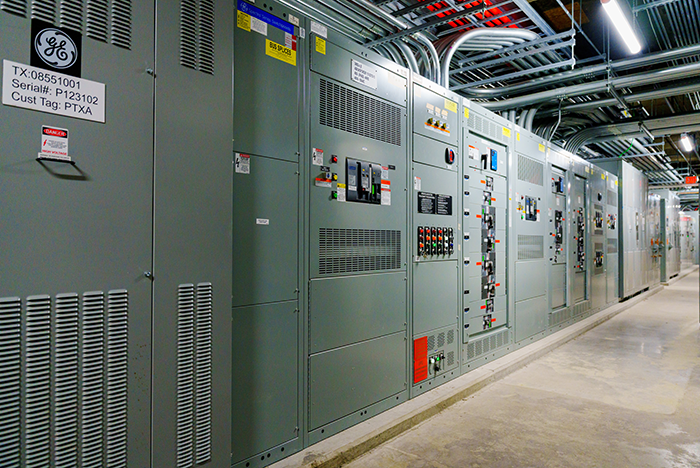
New switchgear and generators are house a new electrical service buildings built on the hospitals ground floor.
Image credit: John Williams, University Health Public Relations
To power this new infrastructure, new emergency generator and electrical service buildings were constructed at the hospital ground level to house new primary electrical switchgear and three new 2,000-kW Cummins diesel generators, replacing the hospital’s three original generators. The facilities team specified during project design that it required up to 96 hours of on-site fuel storage. This resulted in two new 25,000-gallon buried fuel tanks being provided north of the new generator building. The space freed up from removing the original generators provided the location for a new lineup of electrical gear and transformers, replacing the hospital’s original 50-year-old main electrical distribution panels, ensuring full compliance with the National Fire Protection Association’s NFPA 99, Health Care Facilities Code, and providing electrical capacity to fully operate the medical center in the event of a commercial power outage.
Increasing efficiency and resiliency
By the fall of 2021, construction on the new power plants was nearing completion, and the new boiler plant began to come online. During November 2021, University Health Truman’s dependence on district steam use gradually decreased and was finally shut down in February 2022 when the boiler plant became fully operational. Construction of all campus projects and internal renovations was completed by January 2023 when the NICU was completed. This was a monumental undertaking given the challenges brought by COVID-19 and then compounded by a complete replacement of utility infrastructure requiring multiple short-duration electric, steam and chilled water interruptions to perform tie-ins, all while keeping University Health Truman fully operational.
While the power plant replacement projects were in progress, University Health Truman constructed a new 85,000-square-foot medical office building and a new four-level visitor parking structure. The medical center also embarked on a rebranding initiative that required complete replacement of interior and exterior signage and wayfinding throughout the organization. The final cost of all these projects totaled more than $60 million.
Prior to the power plant replacement project, the medical center’s unofficial EPA ENERGY STAR score in 2020 was 11, which was a significant improvement from a score of four in 2017. This improvement was due to internal energy improvement projects, which included replacing multiple air-handling unit variable-frequency drives and LED lighting upgrades, among other energy-improvement initiatives.
By the beginning of 2023, after replacing the inefficient district steam supply with natural gas boilers and high-efficiency electric magnetic bearing chillers, University Health Truman achieved an ENERGY STAR rating of 26, a 135% increase in energy efficiency from 2020. The ultimate benefit of the medical center’s efforts, however, was finally eliminating the major HVA risk of steam line failure, ensuring uninterrupted hospital service to its patients, visitors and staff.
Not just a chore
The monthly and annual chores facilities and safety professionals undertake to ensure standards compliance can pay long-term dividends when recognizing the potential value of these reports and using them as justification to effect positive change and patient care outcomes. The University Health Truman facilities team, executive team and all hospital professionals are immensely proud of what was accomplished in such a short period of time, particularly under difficult pandemic conditions. Members of the Kansas City community who rely on University Health Truman as their essential hospital for care can rest assured they have a well-run facility that will operate effectively and efficiently for another 50 years.
Mike Sullivan, MBA, CHFM, CHSP, is corporate director of facilities at University Health Truman Medical Center in Kansas City, Mo.
Related Articles
NFPA weekly update: Sept. 28 to Oct. 2
A tentative interim amendment to NFPA 99, Health Care Facilities Code, on medical gas piping is open for public comment.

Healthcare may hold the key to long-duration energy storage adoption
Reflections from a healthcare perspective on the Long Duration Energy Storage Summit and the need for resilience and reliability.
County system cuts facility energy costs through partnership
Utility enhancements have driven hundreds of thousands in savings since 2023.