

Energy-intensive buildings deserve special (health) care

Hospitals are extremely energy‑intensive, often leading to real comfort issues like overheating and high humidity.
Image courtesy of Grundfos
Hospitals are among the most energy‑intensive buildings in our cities — a reality that patients and visitors often feel firsthand. According to analysis by the Energy Information Administration, health care buildings represent approximately 2% of the total commercial building stock while accounting for nearly 9% of total delivered energy use. Most people have encountered hospital environments that reflect this imbalance: inpatient wards overheated in winter with windows fully open or waiting areas during summer months where elevated temperatures and humidity create discomfort or, in some cases, exacerbate existing health conditions. These situations are familiar to most people who spend time in health care facilities, and yet they persist despite decades of technological advancement in building systems.
Beyond comfort, these experiences reflect the broader challenge hospitals face in managing energy and resources efficiently.
Compared with other commercial buildings, hospitals consume on average 2 1/2 to three times more energy per square foot than a typical commercial building of similar size. This imbalance underscores both the complexity of hospital operations and the magnitude of opportunity for improvement. Similar patterns have been observed in hospital facilities across Europe, where performance assessments have shown that capacity growth of up to 40% can be achieved through targeted system optimization without increasing overall energy use.
Hospitals are not typical buildings: the complexity of the orchestra
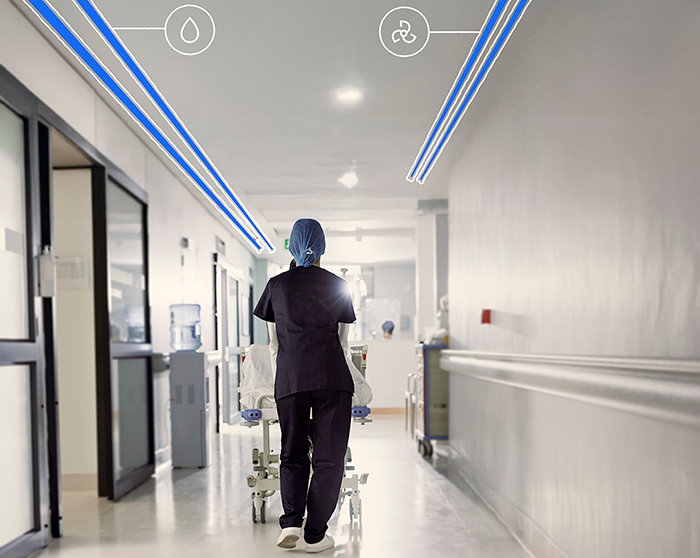
Hospitals operate complex, interconnected systems — including HVAC, water, sterilization, ventilation, etc. — that must respond in real time.
Image courtesy of Grundfos
Hospitals are inherently complex environments. They operate with a vast number of interacting variables: heating and cooling loads that shift by time of day and clinical activity, ventilation requirements tied to infection control, water demand for sanitation and sterilization, and strict redundancy and reliability standards across all systems. Each service follows a similar operational chain in which resources must be generated, conditioned, stored and distributed in real time to meet fluctuating demand. Coordinating these systems is far from straightforward. If driving a car involves managing a limited set of controls (accelerator, brake and steering wheel), running a hospital is closer to orchestrating the movement of thousands of vehicles simultaneously — all while ensuring safety, comfort and compliance. Achieving optimal performance under these conditions is a demanding task, and inefficiencies often emerge when systems operate in isolation rather than as part of a coordinated whole.
A changing global landscape: new pressures reshaping health care facilities

Behind daily care delivery, rising costs, workforce and regulatory pressures are reshaping how health care facilities operate and perform.
Image courtesy of Grundfos
In recent years, however, the context in which hospitals operate has been changing. Rising and volatile energy prices driven by geopolitical uncertainty, increasing water stress and mounting pressure on public health budgets due to aging populations and costly treatments are all reshaping priorities for health care organizations. At the same time, shrinking workforces are straining public finances, public awareness of sustainability issues continues to grow and regulatory requirements increasingly obligate large organizations — including health care providers — to measure, report and reduce their environmental impact. Together, these forces are compelling hospital owners and operators to rethink how their facilities are designed, operated and maintained.
Data from the field: what hospital operators are prioritizing today
Research into operator priorities reflects this shift, as highlighted by findings from a recent independent study:
- Excessive energy use remains a dominant concern, particularly in older hospitals that lack modern controls, insulation or high‑efficiency equipment. Investments in building automation and energy management systems are increasingly viewed not only as tools to reduce consumption but also as enablers of proactive maintenance and data‑driven operational decisions.
- Indoor air quality represents another critical focus area. While high air‑exchange rates are essential to infection prevention and patient safety, outdated ventilation and heat recovery solutions can lead to suboptimal humidity control, unnecessary energy losses or even risks of cross‑contamination. Modern energy recovery approaches, when properly designed and commissioned, help reconcile the need for high air quality with energy efficiency.
- Water consumption also is under scrutiny, as aging infrastructure, leaks and inefficient cooling or sterilization processes contribute to avoidable waste. Leak detection, system monitoring, water reuse strategies and low‑flow fixtures are increasingly recognized as essential components of resilient hospital operations.
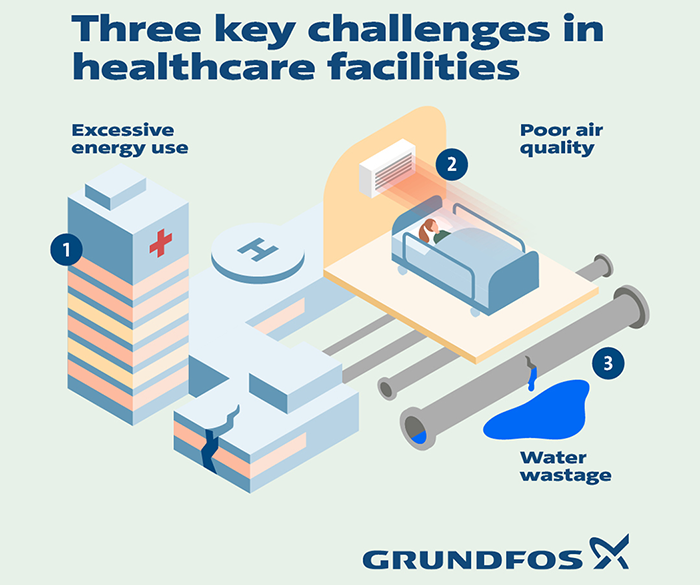
Optimizing energy, air quality and water systems is essential to improving efficiency and patient environments in health care facilities.
Image courtesy of Grundfos
In practice, these priorities often emerge from real operational constraints, such as limited system visibility, imbalanced distribution networks or aging infrastructure challenges that have prompted large multi‑hospital groups to achieve measurable, organizationwide energy reductions by reassessing how existing assets are managed and optimized.
Digitalizing care infrastructure: from reactive maintenance to data‑driven operations
Parallel to these priorities, the role of digitalization in health care facilities management has evolved significantly. Building automation and management systems remain central to hospital operations, but they are now being enhanced with predictive analytics and artificial intelligence capabilities that allow systems to anticipate failures, optimize performance dynamically and adjust to changing conditions over time. These developments support facilities teams in shifting from reactive to proactive asset management.
In practical terms, this is how digitalization changes day‑to‑day work in the plant room. Instead of reacting to alarms after failures have already occurred, facilities teams can identify early signs of performance drift and intervene before issues escalate. Operating conditions, such as pump speeds, flow rates and distribution balance, can be adjusted continuously to reflect actual demand rather than fixed design assumptions, reducing over-pumping and unnecessary energy losses.
The result is not only lower energy consumption but also more stable system operation and longer asset lifetimes — critical advantages in health care environments where unplanned downtime is not an option.
Alongside this evolution, the market has seen the emergence of numerous standalone digital solutions offering similar value propositions through proprietary platforms. While innovation is welcome, many operators are cautious about adding layers of complexity and are increasingly favoring interoperable solutions built on open or nonexclusive standards that integrate seamlessly with existing infrastructure.
Collaboration in action: how technology providers and professional end-users drive superior results
The most impactful results tend to occur when technology deployment is paired with close collaboration between solution providers and in‑house facilities teams. Direct engagement enables operational insights to be translated into tangible performance improvements rather than remaining theoretical. Recent projects in large hospital environments have demonstrated that system‑level optimization (particularly in areas such as hydraulic balancing and cooling distribution) can deliver substantial energy savings while improving indoor comfort and reliability. In one such major hospital in Malaysia, a distributed pumping approach led to a reduction of more than 40% in pumping energy consumption, illustrating how targeted infrastructure optimization can address both sustainability and operational resilience. Comparable system‑level outcomes also have been achieved in other large hospital campuses, where addressing distribution imbalances has delivered measurable reductions in energy use alongside more stable operation.
A pivotal moment: from technical ambition to essential infrastructure
Ultimately, health care facilities are approaching a pivotal moment. The tools required to deliver safer, more comfortable and more sustainable environments — from energy optimization services and digitally enabled retrofits to alternative operational and financing models — are already available. Adoption, however, must be thoughtful and aligned with each organization’s clinical mission, regulatory context and long‑term asset strategy.
In conclusion, the field can acknowledge steps in the right direction. Progress is visible: facilities operators are becoming more proactive, digital capabilities are maturing, policymakers are catching up with regulatory frameworks and cross‑industry collaboration is increasing. Providing safe, reliable and sustainable health care environments is no longer simply a technical ambition; it is an essential foundation for effective care delivery in the years ahead.
Andrea Benvenuti is head of health care vertical at Grundfos.
Related Articles

NFPA weekly update: Oct. 19-23
The National Fire Protection Association is seeking public comments on a proposed amendment for the handling of recalled fire sprinkler products.

ASHRAE guidelines and standards open for comment
ASHRAE/ASHE Guideline 43 Operations Guideline for Ventilation of Health Care Facilities, has a new addendum open for public comment.

NFPA weekly update: Oct. 12-16
The National Fire Protection Association issued a tentative interim amendment to the Life Safety Code regarding noncombustible materials.