

New cooling towers boost efficiency
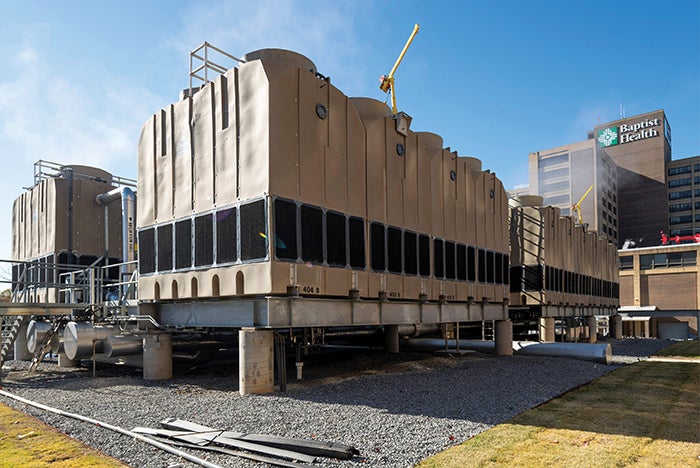
The cooling towers at Baptist Health Medical Center – Little Rock were installed to achieve better energy efficiency and are resistant to the corrosive effects of chemical treatments.
Image courtesy of Delta Cooling Towers Inc.
When Baptist Health Medical Center – Little Rock in Arkansas needed to replace its aging wooden cooling towers, hospital leadership recognized an opportunity not only to upgrade the equipment but also to improve system reliability, flexibility and redundancy. Installed decades ago, the towers were contributing to growing maintenance demands and inefficient energy use across the heating, ventilating and air-conditioning (HVAC) system.
Video footage courtesy of Delta Cooling Towers Inc.
“We knew the original towers were past their life cycle, but as we explored our options, it became clear that this could be an opportunity to improve more than just reliability,” says Hamid Habibi, the hospital’s project manager. “We wanted to make this a more comprehensive project where we could improve our operation, not only with redundancy but also with energy efficiency.”
While the broader energy initiative successfully delivered both energy savings and operational improvements, the new engineered plastic cooling towers also contributed to the project success with improved operation and flexibility. Most of the work took place in 2024, and the job was completed in early 2025.
In total, Baptist Health Medical Center – Little Rock installed 20 engineered plastic cooling tower cells from Delta Cooling Towers Inc.’s TM series. The tower cells provide a total cooling capacity of 7,000 tons. Made from high-density polyethylene (HDPE), the cooling towers also provide significant energy savings to the medical center. Moreover, HDPE systems often can be installed in just a day or two, compared to days or weeks required for towers made from other materials.
The energy savings delivered by these cooling towers can be attributed to three key features: a modular design, multiple efficient motors and fans, and the use of variable-frequency drives (VFDs). Since the upgrade, the hospital has been able to reduce energy consumption by approximately 50% on each unit by operating the fans at 80% speed or less.
“Due to the number of issues the hospital had experienced with the existing wooden towers, the corrosion-proof structure as well as the 20-year warranty that came with the engineered plastic design were features that were attractive to the hospital in selecting the new towers,” says David Buie, an account manager in controls sales at Powers, an HVAC, controls and service contractor based in North Little Rock, Ark., that assisted with the project.
“Because of the way Delta’s towers are separate cells that work together, the hospital can stage them down when they’re not all needed,” explains Buie. “This can amount to huge savings on energy.”
The modular design allows for precise load management, and each unit is equipped with smaller 60-inch fans, which reduces energy consumption. Each cell contains two fans — all powered by VFDs that automatically reduce motor output when full fan speed is not required. With 40 motors, the energy savings are extensive.
“In addition to the superior turndown capabilities of the HDPE cooling towers, another feature that stood out was that these units include much smaller motors — 15 horsepower (hp) compared to 150 hp in the stainless-steel alternative — further contributing to long-term energy savings,” explains Habibi.
Additionally, while all cooling tower systems require chemical treatments to control algae, pathogens and sediment buildup, which can hinder performance, the HDPE towers at Baptist Health Medical Center are immune to the corrosive effects of these chemicals.
Through careful selection of its cooling tower system and strategic mechanical upgrades, Baptist Health Medical Center – Little Rock achieved measurable, long-term power savings without compromising compliance requirements or patient care priorities.
Related Articles

NFPA weekly update: Sept. 28 to Oct. 2
A tentative interim amendment to NFPA 99, Health Care Facilities Code, on medical gas piping is open for public comment.

Healthcare may hold the key to long-duration energy storage adoption
Reflections from a healthcare perspective on the Long Duration Energy Storage Summit and the need for resilience and reliability.
County system cuts facility energy costs through partnership
Utility enhancements have driven hundreds of thousands in savings since 2023.