

Unclench your jaw to learn about stress and self-awareness

Image from Getty Images
Alarm. 20 emails. Shower. Breakfast. 27 emails. Walk the dogs. Help get the kids out the door. 31 emails. Commute. Congestion. 36 emails. Finally sit down at your desk. Four voicemails. Five meetings. 42 emails. Commute. Congestion. Walk the dogs. Dinner. Phone call about an emergency issue. Read the kids a bedtime story. Doomscroll. Sleep. Alarm. Over. And over. And over. It. Is. Enough. To. Make. You. Scream.
Our age may be post-modern, but our biology is still post-Stone Age. Stress responses were super helpful when (LION!) there was something (TIGER!) that we needed to (RHINOCEROS!) run away from. Less helpful when that stress trigger is responding to a message that starts with, “As per my last email.” Unlike our fear-inducing four-legged foes, you can’t outrun workplace stress.
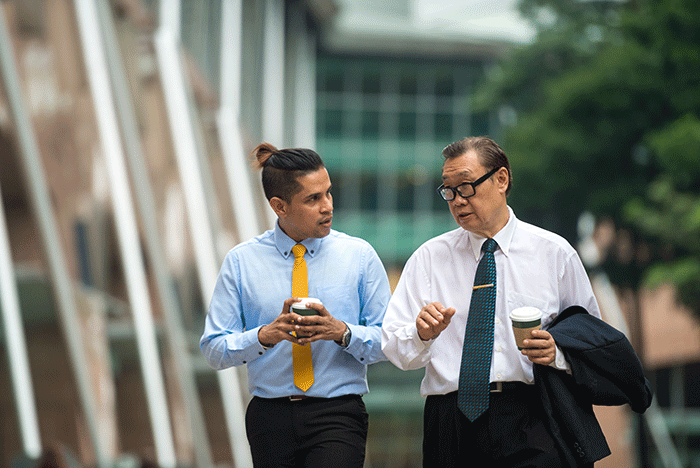
If you’re reading this at work, my guess is your body is already responding to those stresses without you knowing it. Right now, right this moment, check in with your body. Are your shoulders bunched up by your ears? Does your scalp feel tight? If so, were you aware of their states before you did this check-in? Most of us are not.
We walk through each day accumulating stressors, from meetings that didn’t go how we expected, to interactions with others making differing and implacable decisions that impact our day to day, to the vicissitudes of the breaking point of a single component of a complex system that chose Monday at 4:30 p.m. to wreak havoc on the ceiling tiles on the third floor. It’s a given that these moments are out of our control. It’s a given that these moments will stress us out. It is a gift that being self-aware about our own stress tolerance is a subset of social/emotional intelligence that we can work to improve on our journey to obtain mastery of this power skill.
What is stress?
The American Psychological Association's (APA’s) Dictionary of Psychology defines stress as “the physiological or psychological response to internal or external stressors,” which impact nearly all body systems, manifesting as changes in our emotions and behavior. We all know what this definition feels like in our bodies. Our heart starts to race. Our palms, neck, and armpits start to sweat. Our muscles tense (Hi, my name is Adam, and I’m a jaw clencher). We become irritable, curt, sometimes timid, sometimes fearful. It’s all terrible. It’s all textbook stress response.
In our society, we are comfortable talking about external stressors — bosses, business cycles, big rigs almost swiping us when we pull onto the highway. In our society, we are comfortable talking about acute drivers of stress — a lost deal, a mistake in a report, a missed flight. We are not comfortable talking about internal stressors — conversations with our partner we know went south because of something stupid we said, considerations of whether it’s the right time to ask for that raise or comparing our 12--year-old Hyundai with Chris’s brand-new Infiniti. We are not comfortable talking about chronic drivers of stress. Did I make the right choice 15 years ago when two paths diverged? Can I connect effectively with my partner? Why am I here? Increasing our tolerance of stress starts with noticing all types of stressors — external and internal, acute and chronic.
Those stress drivers, wherever they come from, have a significant impact on our individual and organizational bodies. In her 2019 Psychology Today article “The Obliterative, Dislocating Effects of Stress,” Sylvia Karasu, M.D., points out that “sustained toxic stress can impact the part of the brain responsible for executive function. This negative impact can weaken working memory, attention control, cognitive flexibility, and problem-solving.” Being more aware of stress and improving your tolerance of stress aren’t touchy-feely, woo-woo actions. These are practical, analytical responses to a corrosive substance, putting out a fire before it burns through.
What is the relationship between stress tolerance and self-awareness?
One of my favorite poets is Mary Oliver. Writing in an essay for the anthology “A Sense of Wonder,” Oliver said, “In the beginning I was so young and such a stranger to myself that I hardly existed. I had to go out in the world and see it and hear it and react to it before I knew at all who I was, what I was, and what I wanted to be.”
This observation can be ascribed to the act of growing from child to adult. It also can be ascribed to the growth we achieve within our professional careers. We often don’t know how we are going to react to unforeseen circumstances at work until we have had time to experience them and gain more awareness of how we chose to respond to them. Self-awareness is about choosing to pay attention to ourselves. Can we observe our emotions while we are feeling them? This is often easier with positive emotions. It is hard to ignore the feeling of a smile on your face or a good belly laugh. It can be more difficult to be aware of our negative emotions as we are feeling them. They have such an intensity within our physiology that it can be overwhelming.
One of our trusted guides on this in-depth discussion of self-awareness is organizational psychologist Tasha Eurich, Ph.D. In her 2018 article in Harvard Business Review “What Self-Awareness Really Is (and How to Cultivate It),” Eurich says research indicates that “only about 15% of people are sufficiently self-aware and that there is less than a 30% correlation between people’s actual and self-perceived competence.” She goes on to describe how a “leader’s lack of self-awareness negatively impacts decision-making, collaboration, and conflict management.” This statistic should be both comforting (OK, 85% of people aren’t sufficiently self-aware) and alarming (OK,85% of people aren’t sufficiently self-aware?!) Decision-making, collaboration, and conflict management are common actions we all perform throughout our workday and throughout our careers. The fact that you’re reading this article indicates you want to be among the 15% of people with sufficient self-awareness to improve your decision-making, collaboration and conflict management prowess.
Acclaimed psychologist Carl Jung once said, “I am not what happened to me; I am who I choose to become.” Stress, whether internally or externally generated, is an outcome of what happens to us. Stress tolerance, or how we respond to stress, is what we choose to become in the face of those drivers. But one must be able to observe those stressors’ impacts on our emotional and behavioral state to be able to make an effective choice about our responses to them. You cannot improve your stress tolerance if you are not aware that you’re stressed.
How do I improve my stress tolerance?
While Buddhism teaches us that change is a constant in the universe, we seem to be getting extra servings of change compared to other ages. Lucky us, right? Thanks, universe! This state of flux is driving up feelings of stress and anxiety around the world. According to the APA’s annual mental health poll, 43% of U.S. adults reported feeling more anxious in 2024 than in the previous year, up from 37% in 2023. Global pandemics. Wars. Financial instability. I’m looking for a normal business cycle; can you help me find it?
Improving your stress tolerance is more important than ever considering the age we live in. The first place to start improving your stress tolerance is with self-compassion. In their 2020 McKinsey & Company article “How to demonstrate calm and optimism in a crisis,” Jacqueline Brassey and Michiel Kruyt point out, “Compassion and acceptance for self and others is an essential ingredient for leaders who want to be deliberately calm. It is only human to react impulsively to stressful events. And we may regret this and feel ashamed about it. In these moments it is important for leaders to emphasize self-care and self-compassion.”
Your calmness and self-compassion can help not only improve your own stress tolerance but can also be a signal to others. Brassey and Kruyt go on to say, “Being deliberately calm can have a multiplier effect on communities. How humans are ‘wired’ to share emotional cues has been researched extensively. Leaders’ emotions have a big impact on an organization: when a leader is impatient, fearful, or frustrated, people begin to feel the same way, and their feelings of safety diminish. On the other hand, when a leader is hopeful and calm, the group can face challenges more creatively.”
After self-compassion comes self-leadership. Julia Tenschert, Marco Furtner and Mike Peters describe self-leadership in their 2024 Management Review Quarterly article “The effects of self-leadership and mindfulness training on leadership development: a systematic review” as "an approach to motivation and responsibility that can be contrasted with external leadership or outside direction. Self-leadership is defined by personal responsibility and initiative, setting and monitoring one’s goals, and effectively employing strategies to improve performance or well-being.” Self-compassion teaches you to accept your physiological response to stress. Self-leadership teaches you how to gain agency over your responses, which helps you to lower stress levels by acting on what is within your control and accepting that which is not.
After self-compassion and self-leadership comes mindfulness. The article describes mindfulness as a “habit of awareness and mental presence regarding one’s immediate surroundings.” Think of mindfulness as a tool for hyper-focus on the present. When it’s Monday at 4:30 p.m. and your ceiling tiles are falling apart because of that system breakdown, worrying about how long your drive home is going to take isn’t going to help with the crisis at hand.
The combination of self-leadership and mindfulness has a multiplier effect when it comes to improving stress tolerance. As their article continues, Tenshert, Ferner and Peters describe the two as sharing “a core of self-regulatory qualities, and both have direct beneficial effects on leader and firm/team performance. By combining the motivational, performance-related, and organizational benefits of self-leadership with the well-being and epistemic benefits of mindfulness, leaders can become more aware of and more able to control their emotions, behaviors, and ideas, which ultimately helps them develop self-awareness that is intrinsically empathetic and action-oriented.”
What these authors’ research tells us is that not only should we learn the habits of self-leadership and mindfulness ourselves, but that organizations should be incorporating them into their onboarding or training processes. “The combination of these two powerful tools provides an integrated strategy for leadership that fosters an innovative, resilient, and morally sound culture within companies in addition to increasing personal efficiency,” the authors write. In an age where epoch-defining changes are just our regular Tuesday, organizations that can supply their employees with the tools required for improved stress tolerance are going to be the ones that will generate enduring success.
How can I stop stressing about improving my self-awareness?
Buildings are built with sweat along with steel and concrete. Complicated systems like heating, ventilating and air-conditioning systems require human ingenuity and focus to run as much as they do electricity. Accomplishing hard things takes hard work. Improving your emotional/social intelligence takes as much sweat, human ingenuity and focus as any other complex system. Perform some self-care by simply accepting this fact.
However, just because the work is hard does not mean that you need to heap stress onto yourself about doing this important work. The effort will pay off in the same way a building once built becomes a home or a hospital. As American Founding Father Benjamin Franklin taught us, "Without continual growth and progress, such words as improvement, achievement and success have no meaning.” So, stop stressing out about improving your self-awareness. You’re building scaffolding for your success and foundations for your future. Now get to work on making that future you a reality.
Adam Bazer, MPD, senior director of thought product development, ASHE.
Related Articles

The big shift in annual incentive bonuses
More facilities professionals report bonuses being tied to clinical performance and patient safety goals.

Celebrating excellence, advancing the field
The Center for Health Design's President and CEO Debra Levin reflects on the significance of recognition for a rigorous, high-impact field..

How to quantify facilities competence
From certification to professional licensure, investing in staff competence helps to ensure facilities are prepared for whatever may come.