

The big shift in annual incentive bonuses
Bonuses are rarely a guarantee, but they sure are nice to have. According to the 2025 Salary Survey by the American Society for Health Care Engineering’s Health Facilities Management (ASHE/HFM), 41% of respondents said they received bonuses in 2025. Although that’s down from a high of 46% of respondents receiving bonuses in 2021, it is a nice, if modest, rise from 2023, when only 38% received bonuses. The survey’s respondents include all manner of health care facilities professionals, including facilities engineers, architects, constructors, environmental services (EVS) staff and security personnel.
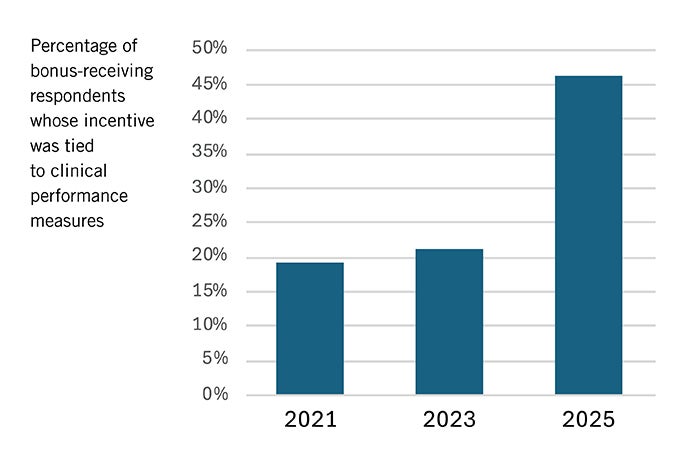
Click chart to expand and view data
Of the 41% who did get bonuses, according to the 2025 data, 60% received more than $5,000, and two-thirds of that group received more than $10,000. Data from the survey dating back to 2012 shows that those receiving more than $10,000 have always accounted for the largest percentage of respondents, and it’s been steadily rising. In 2012, only 21% of respondents received a bonus of more than $10,000, compared to 39% in 2025’s survey.
Though the percentage of facilities professionals receiving more generous bonuses continues its steady incline, data shows that it comes with a fair share of work. To paraphrase Theodore Rooselvelt, “Nothing good ever comes easy,” and the same is true for ASHE/HFM Salary Survey respondents.
Since 2019, well over 80% of bonus-receivers said their incentive compensation is tied to a performance improvement initiative or outcome. In 2025, that number hit a high of 88% of respondents. In that respect, not much has changed. What has changed, however, are the improvement measures bonuses are being tied to.
Last year’s survey came with some notable shifts regarding which performance targets and goals trigger the flow of bonuses. Since introducing the multiple-choice question in 2017, “Please indicate to what targets or performance measures your bonus is tied to,” the No. 1 response has been “meeting budgetary goals.” In 2017, 90% of bonus-receivers checked this option, and it has hovered in the upper 80% range in every survey until 2025, when it dropped to 70%. Although it is still the top selected answer, the more than 10% drop from previous surveys stands out, especially when held up against those options that saw notable increases.
For instance, those who said their targets are now tied to clinical performance measures saw a significant jump from 19% and 21% in 2021 and 2023, respectively, to 46% in 2025. The option of patient safety planning also saw a marked increase — only 12% and 13% of respondents selected this option in 2021 and 2023, respectively, versus 21% in 2025.
Considering the ASHE/HFM Salary Survey’s respondents are comprised of health care engineering, architecture, construction, EVS, security professionals and the like, rather than physicians, pharmacists, nurses and imaging technicians, seeing clinical-related performance measures jump while budget-related goals take a dip is worth examination.
For decades, ASHE has made the case that facilities-related professionals are not an island unto themselves. Instead, the work done by facilities professionals has an impact on a hospital’s day-to-day patient care outcomes.
A hospital’s design can help or hinder clinical workflows. Construction projects that are adjacent to occupied spaces require vigorous adherence to infection control risk assessments to prevent health care-associated infections. Ventilation management plans ensure air is flowing in the direction it needs to be and changing over at the rate it is supposed to. EVS procedures ensure facilities are not just visibly clean but that invisible deadly pathogens are eliminated as well. Emergency management plans ensure that when the local grid goes down in the middle of a storm, backup power is supplied within life-saving seconds.
So, while more health care facilities professionals reporting that their annual bonuses are being tied to clinical performance measures and patient safety planning is a new change within the ASHE/HFM Salary Survey, the daily responsibilities of these professionals indicate that the physical environment has always been inextricably linked to patient care. Perhaps the 2025 data on incentive bonuses is merely a sign that executive leaders are recognizing the same.
Jamie Morgan is senior editor of Health Facilities Management.
Related Articles

Security ecosystem helps manage risk
City of Hope partnered with Motorola Solutions to developed a layered security strategy for its 100-acre California campus.

Healthcare proposals help shape 2027 I-Codes
With the 2027 International Code Council code cycle complete, here’s a review of successful changes advocated for by the Committee on Healthcare.

Say, ‘Yes, Chef’ to improving your influence in the workplace
Mastering the many forms of influence in the workplace will help you achieve your career goals.