

Security ecosystem helps manage risk
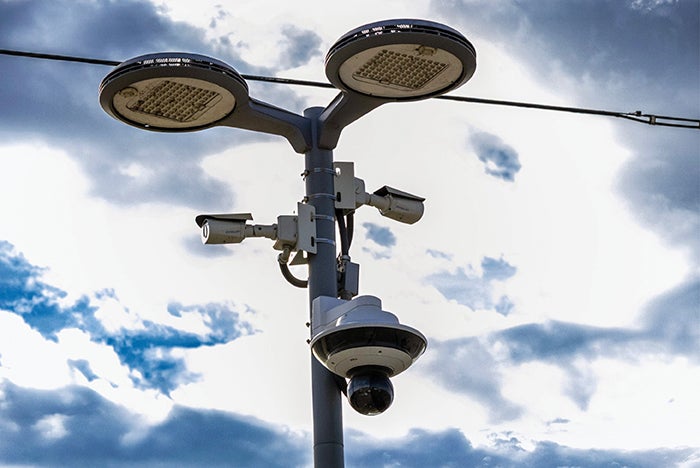
Avigilon security cameras create a virtual fence line to monitor the perimeter of City of Hope’s large hospital campus.
Image courtesy of City of Hope
City of Hope in Duarte, Calif., sits on 100 acres in northeast Los Angeles County and serves as a leading destination for cancer research and treatment. It employs 10,000 staff members who support thousands of patients and visitors each day, and its mission depends on maintaining a campus environment that is welcoming and secure.
For health care facilities and security leaders, that responsibility has become more complex as hospitals face rising rates of workplace violence, trespassing and property crime. In response, City of Hope worked with Chicago-based Motorola Solutions, with which the cancer center already had a trusted relationship, to increase security technology.
By working together to understand the immediate operational challenges, the two entities developed a future-focused security strategy with scalable solutions that integrates into the current environment and is designed to grow alongside the organization.
Since 2024, City of Hope’s security personnel have been able to identify threats earlier and respond more effectively across its large, open campus through the use of Motorola Solutions’ artificial intelligence (AI)-enabled Avigilon security cameras and video management software.
The campus includes 90 buildings and is located in a busy area of the city, which can contribute to higher rates of trespassing and theft. At the same time, health care staff face increasing incidents of verbal and physical aggression tied to wait times and emotional strain.
“Health care is disproportionately impacted by workplace violence, with staff facing risks at a higher rate than front-line workers in other industries,” says Mark Reed, executive director for City of Hope’s campus support operations. “Addressing this situation is a top priority so that caregivers — as well as all workers and visitors to our campuses — feel just as safe and protected as our patients.”
City of Hope models a progressive approach to security infrastructure thanks to the seamless integration of fixed cameras, license plate recognition technology, Halo smart sensors and two-way radio communications that are cohesively managed from a centralized, cloud-based security operations center.
An early use case focused on strengthening the perimeter while maintaining an open, healing environment. Rather than investing millions in new fencing, the security team added cameras, effectively creating virtual fence lines along vulnerable campus areas. When the system spots activity in restricted zones, analytics enable security to receive intelligent alerts. This provides a more efficient and cost-effective solution for monitoring the perimeter while allowing security staff to intervene early.
For added protection, Halo smart sensors were installed in lobbies, common areas and select clinical spaces. The sensors can detect airborne contaminants such as smoke and vaping activity; monitor air quality, temperature and carbon dioxide levels; detect gunshots; and identify keywords such as “help” and “emergency.” During regional wildfires, the devices helped monitor indoor air conditions, allowing staff to take appropriate action to protect patients and other occupants.
Two-way radios help improve communication between security officers in the field and the operations center. Additionally, license plate recognition has proven vital in curbing vehicular-related offenses. During a regional surge in catalytic converter thefts, the recognition system flagged vehicles linked to prior incidents, providing the intelligence needed for local law enforcement to make an arrest. This data also feeds into workplace violence committees to drive long-term strategy.
“Our goal overall is to identify and address potential issues at the furthest point possible from our care areas,” Reed says. “By receiving actionable alerts at the perimeter, we can engage early to help insulate our staff and patients from external disruptions.”
Since deploying and integrating Motorola Solutions’ AI-enabled ecosystem of security solutions, City of Hope has reported measurable improvements. Response times to trespassing incidents decreased by 64%, allowing security teams to resolve issues before they escalate. Video review time dropped by 43%, freeing staff to focus on active monitoring rather than manual investigation.
For City of Hope, its ecosystem of integrated security technology is a critical tool for managing risk across its campus by improving response times, reducing investigative workload and providing earlier visibility into potential threats.
Related Articles

Nuvolo launches regulatory compliance management to tie survey readiness directly to maintenance work
New capability maps regulatory standards to assets so healthcare organizations can build compliance evidence as work gets done.

Optimizing healthcare infrastructure through enterprise asset management
How Montefiore Einstein implemented a single source of truth for building spaces and infrastructure assets.
Healthcare proposals help shape 2027 I-Codes
With the 2027 International Code Council code cycle complete, here’s a review of successful changes advocated for by the Committee on Healthcare.