

The benefits of professional certification
Click image to expand
For professionals seeking career advancement and higher earning potential, professional certifications provide a proven route to achieving both. The American Society for Health Care Engineering’s biennial Salary Survey conducted by Health Facilities Management magazine showcases quantitative and qualitative data to back up that claim.
The study surveys a wide spectrum of professionals, from facilities and construction managers to environmental services and infection prevention leaders. When looking at professionals who have obtained professional certifications versus those who have not, the survey repeatedly shows that the former tends to earn more than the latter.
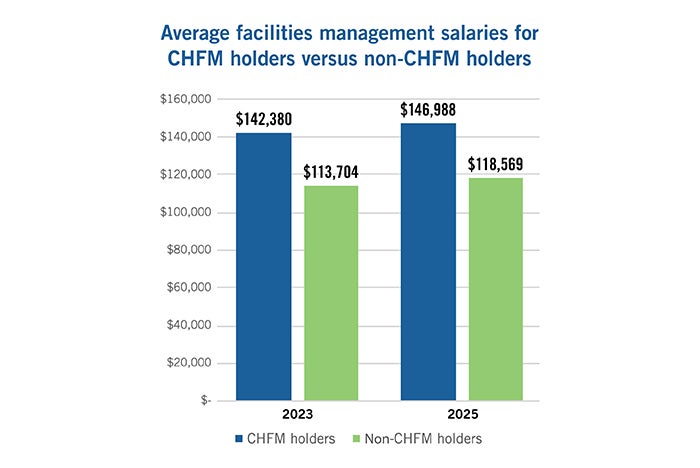
Considering those who marked “facilities management” as their primary area of responsibility, for instance, we see that holders of a Certified Health Care Facility Manager (CHFM) earned 21% more and 20% more than their non-CHFM counterparts in 2025 and 2023, respectively.
One respondent reported, “I was able to obtain my credentials at a point in my career that allowed me to apply for and obtain positions of increased responsibility and compensation.” Another responded saying their certification allowed them to obtain a 10% increase in pay.
Others say their certification allowed them to unlock roles they otherwise would have been shut out of.
As one respondent put it, “Because of my CHFM credential, I was hired and assigned to a new hospital building project as an owners’ representative. It afforded me the opportunity to share my experiences and the insights I have gained from my years of training and from my accumulated experiences.”
Others report landing director-level positions at new organizations after obtaining their certifications.
“I achieved CHFM while at one organization hoping for advancement,” one respondent said. “Advancement did not mature [at that organization], but I feel this certification helped me land the director position I currently hold.”
Stories such as these illustrate why the majority of 2025 Salary Survey respondents say their certifications provide either major or moderate value to their careers. An even higher number say their certifications provide major or moderate value to their organizations.
Some of the nonmonetary benefits respondents shared include the ability to impact and improve operations. “The CHFM certificate was a validation of my skill sets in managing safe, secure and healthy environments for patients and colleagues,” one respondent said.
Others have become a go-to resource for peers and staff: “I have held my Trainer-Certified Health Care Environmental Services Technician (T-CHEST) since 2017. Since that time, we have trained more than 100 technicians to become CHEST-certified. Many of these have advanced up the career ladder because of this training.”
Many respondents also say their certification allows them to better navigate accreditation surveys.
“I think accrediting organization surveyors really value certifications,” one respondent said. “It is a signal that you care and that your organization cares. In my experience, surveyors are more open to listening to feedback and having discussions surrounding code interpretations when you have relevant certifications.”
Another respondent reported similar experiences.
“Thanks to the training and frameworks I had mastered during the certification process, I was able to lead a comprehensive internal review, identify gaps and implement corrective actions well ahead of an audit,” they said. “Not only did we pass with commendation, but the auditors also specifically noted the proactive risk management strategies we had adopted. That moment reinforced the real-world value of the certification — not just in theory but in protecting the organization’s reputation and ensuring operational excellence.”
Numbers speak, and reports of significantly higher salaries being linked to certification are loud and clear. It can be harder, though, to quantify some of the other benefits of certification. Hopefully, these stories shared by Salary Survey respondents demonstrate that certifications not only provide incentives for professional development in the health care facilities field but also advance the field as a whole.
About this column
“Data Insights” dissects information collected through the American Society for Health Care Engineering’s Hospital Operations, Hospital Construction and Salary surveys. The column pulls from original research to discuss nuanced issues affecting health facilities professionals across the United States.
Related Articles

Nuvolo launches regulatory compliance management to tie survey readiness directly to maintenance work
New capability maps regulatory standards to assets so healthcare organizations can build compliance evidence as work gets done.

Optimizing healthcare infrastructure through enterprise asset management
How Montefiore Einstein implemented a single source of truth for building spaces and infrastructure assets.

Security ecosystem helps manage risk
City of Hope partnered with Motorola Solutions to developed a layered security strategy for its 100-acre California campus.