

Getting on the same page at the start of a project

When teams define problems precisely and collaborate early, budgets become more reliable, decisions are made with greater confidence and outcomes are more successful.
Image by Caleb Tkach, AIAP, architectural photographer
Escalating construction costs are a defining challenge for healthcare organizations. While healthcare leaders have become increasingly disciplined in planning capital investments, today's inflation, labor shortages and supply-chain volatility make early decision-making more consequential than ever.
In many cases, budget pressure originates long before construction begins — not because of poor planning but because budgets often must be established before existing conditions are fully understood, scope is validated or key partners can help test assumptions.
With margins tightening and patient experience expectations rising, how a project starts now matters as much as how it’s delivered. Too often, teams repeat the same cycle: confidence at approval, discomfort in design, anxiety at pricing and disappointment when scope must be reduced. The impact isn’t just financial — it affects trust, operations and long-term performance.
The best path to control cost is better alignment at the beginning. Persistent overruns are rarely design failures — they’re understandable process challenges rooted in how projects are framed and the conditions upstream. Here is how strong alignment at the outset of a project resolves budget challenges.
Understanding the building
Many healthcare organizations come into a project with a preapproved budget and scope that seem aligned — at least on paper. And the intent makes sense. Leadership seeks clarity, internal teams want to keep things moving and capital planning cycles tend to reward decisiveness. But the challenge is that these budgets often are set before teams truly understand the building itself — its existing conditions, infrastructure realities and the code requirements that ultimately drive cost.

Budgets often are set before teams truly understand the building itself — its existing conditions, infrastructure realities and the code requirements that ultimately drive cost.
Image by Alise O'Brien Photography
Renovations are especially vulnerable. What begins as a straightforward upgrade can quickly expand once the building is assessed. Suddenly, the scope extends beyond layouts and finishes to include mechanical, electrical, plumbing and life safety work that isn’t optional. When those needs surface after funding is approved, teams face painful trade-offs. Infrastructure must be covered first, leaving less money for the spaces stakeholders expected. Often, the only lever left is reducing scope — an outcome that erodes confidence and strains relationships.
Consider this scenario illustrating how quickly this gap can appear: An organization presents a scope and budget that initially seem aligned. After evaluating the existing facility, the team identifies roughly $4 million in missing infrastructure required to meet code and long-term performance goals. The project moves forward, but only after difficult decisions — less renovated square footage in the near term paired with a plan to address additional areas later. The compromise protects long-term value through improved reliability, energy performance and compliance. Early evaluation allows organizations to align funding with the building’s needs before a budget is approved. With that clarity, teams can establish a realistic scope and move forward with confidence.
A flexible scope
Internal planning teams often are tasked with defining scope independently, using square-footage targets or precedent projects as shortcuts. While this is efficient, it limits exploration of alternative solutions that may address the underlying need more effectively — sometimes at comparable or lower cost. A more strategic approach starts with a different question: What problem is the organization actually trying to solve? Scope is not the goal — it is one possible solution.
Problem-first framing doesn’t have to be complicated. “We need an addition” often is a conclusion not the problem. The underlying drivers may be capacity constraints, patient flow inefficiencies, projected surgical growth or an outdated mix of semi-private rooms. Starting with a clear problem statement allows teams to consider multiple strategies, each with defined impacts on cost, schedule and operational continuity.
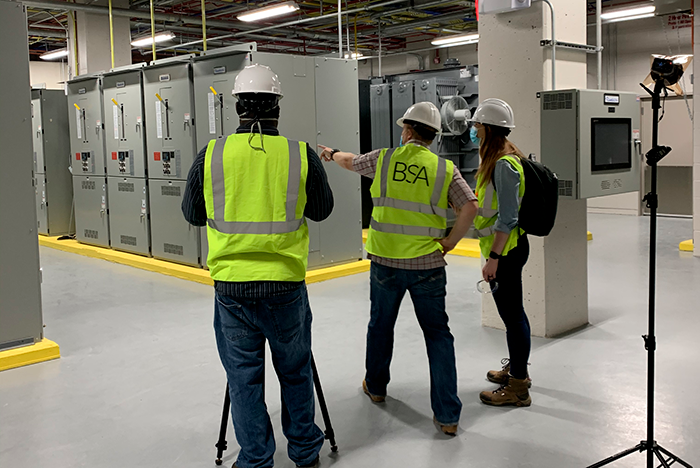
Renovations are especially vulnerable when what begins as a straightforward upgrade can quickly expand once the building is assessed.
Image courtesy of BSA
This shift changes the emotional dynamic of budget alignment. When the scope is treated as fixed, any reduction feels like failure. But when scope is treated as a hypothesis, evaluating options becomes part of responsible planning. Leaders can intentionally compare trade-offs rather than react to late-stage pricing shocks.
Options-based planning is especially valuable in healthcare because every solution carries consequences. Some approaches may be more expensive but less disruptive to operations. Others may be faster but require more complex phasing. Still others may deliver stronger long-term flexibility at a higher initial cost. When teams present multiple viable options, each solving the same problem in different ways, leaders can align investment with priorities early, before pressure forces compromises later. To test scope assumptions effectively, organizations can proactively seek input from partners who understand cost and constructability best.
A recent community hospital planning effort illustrates the value of this approach. Although the organization had a highly capable internal planning team, limited capacity made it difficult to evaluate every variable comprehensively. By engaging planning, design and construction (PDC) partners early, the team simultaneously analyzed service-line demand, infrastructure, code compliance, patient access, parking, wayfinding, operational flow and the overall patient experience. The assessment revealed aging infrastructure, code deficiencies, space constraints within surgical services and opportunities to improve patient satisfaction.
Rather than advancing a single predetermined solution, the team developed three options with distinct costs, phasing strategies, constructability considerations and long-term operational benefits. With the construction manager providing real-time input on cost and constructability, hospital leadership was able to select a path forward based on clear data, informed trade-offs and a shared understanding of both immediate needs and long-term goals.
Early collaboration
Early involvement of architects and construction managers can dramatically improve cost certainty. Still, many organizations understandably hesitate due to perceived risks: added upfront expense, internal role protection or fear of slowing approvals. Ironically, these concerns can lead to further delays and increased costs later.
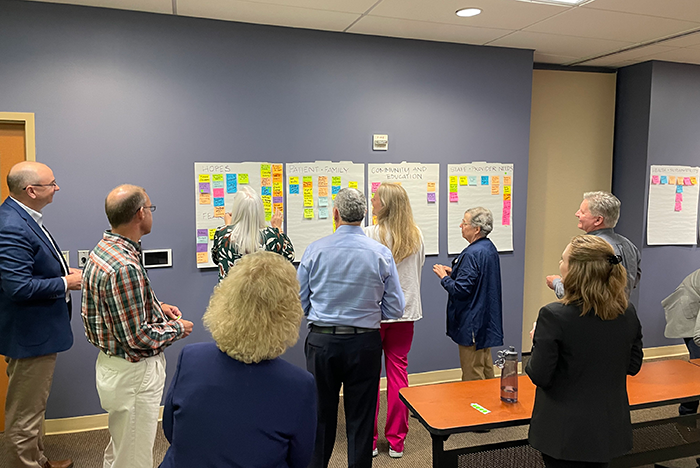
The best path to cost certainty isn’t value engineering at the end but better alignment at the beginning.
Image courtesy of BSA
One of the strongest benefits of early collaboration is credibility. Construction managers are actively buying systems and materials every day, providing real-time market intelligence on pricing, labor availability and supply chain constraints. That input helps reset expectations early, when decisions can still be adjusted without significant disruption.
Early collaboration also improves practical decision-making. Healthcare projects must account for phasing, infection control, operational continuity and campus logistics — factors that can dictate both schedule and cost. Evaluating these realities early helps teams identify risks sooner and develop solutions that work in the real environment, not just on paper.
Internal dynamics can be a barrier. PDC groups often are responsible for developing programs and scopes for financial leadership. Yet, a more productive model is collaboration rather than replacement — external partners bring bandwidth and recent experience, while internal teams retain leadership and institutional knowledge.
Modest early investments to validate scope and budget can usually be absorbed into overall project fees. In large capital programs, spending early to define the right project is risk reduction — not overhead. Even with early collaboration, cost certainty can still erode if market realities aren’t communicated clearly and continuously.
Current market insight
Post-COVID-19 volatility has made it difficult for owners to maintain an accurate understanding of construction costs. Without current market data from teams actively pricing and buying systems, expectations can drift far from reality, creating frustration on all sides. This disconnect often is the most challenging part of alignment. Owners may hope costs will come back down, but construction pricing rarely reverses. Costs may stabilize and escalation may slow, but projects generally become more expensive over time.
At the same time, healthcare systems are being pulled in two directions. They’re under pressure to improve financial performance while also being asked to elevate the patient experience. Patient satisfaction now directly impacts competitiveness and reimbursement, yet margins are tightening due to rising operational costs and ongoing uncertainty in reimbursement models. That tension makes cost surprises especially painful and makes early clarity even more critical.
The solution is not simply better estimating — it is proactive cost education delivered early enough to shape decisions. Teams that bring real-time pricing insight into early conversations can help leaders understand what drives cost, where investment adds long-term value and where simplification can still meet goals. Transparency about trade-offs is essential: Decision-making stakeholders can accept constraints, but they rarely accept surprises. When cost education becomes proactive rather than reactive, organizations can shift from late-stage damage control to early-stage alignment.
Another health system preparing for a major capital program demonstrated how proactive cost education can strengthen decision-making. While the organization’s PDC leader had a strong understanding of today’s healthcare construction market, executive leaders and board members brought expectations shaped by other sectors. Rather than asking stakeholders to accept projected costs, the project team assembled benchmark data from comparable acute-care and ambulatory projects completed over the past decade. It escalated those costs to current market conditions.
Presenting objective, market-based information helped establish a common understanding of today's construction environment, giving leadership greater confidence in budgeting decisions and creating alignment around realistic investment expectations before the program advanced.
A better starting point
Healthcare organizations don’t need lower ambition to avoid budget disappointment — they need a better starting point.
The most effective strategy is simple: Define the problem before defining the project, and let that clarity guide scope, budget and decision-making. Early engagement with key project team members helps test assumptions with real-time market insight and develop options with clear cost, schedule and operational impacts — before approvals lock in expectations.
In an era of tightening margins and rising expectations, the solution isn’t more aggressive cost-cutting at the end, but stronger alignment at the beginning. When teams define problems precisely and collaborate early, budgets become more reliable, decisions are made with greater confidence and outcomes are more successful.
Kevin Token is principal and board chair at the design firm BSA. He can be reached at ktoken@bsadesign.com.
Related Articles

NFPA weekly update: Sept. 14-18
A tentative interim amendment on weapons detection systems was added to NFPA 5000, Building Construction and Safety Code.

The facilities manager’s role in reducing healthcare-associated infections
From multidisciplinary communication to establishing safety procedures for construction, remediation and maintenance, facilities teams play a critical hand in reducing patient infections.

AdventHealth expands in Tampa Bay with new patient tower
Expected to open in 2029, the new six-story patient tower at AdventHealth Carrollwood will expand inpatient and surgical services for the rapidly growing area.