

Furniture manufacturers focus on healing comfort
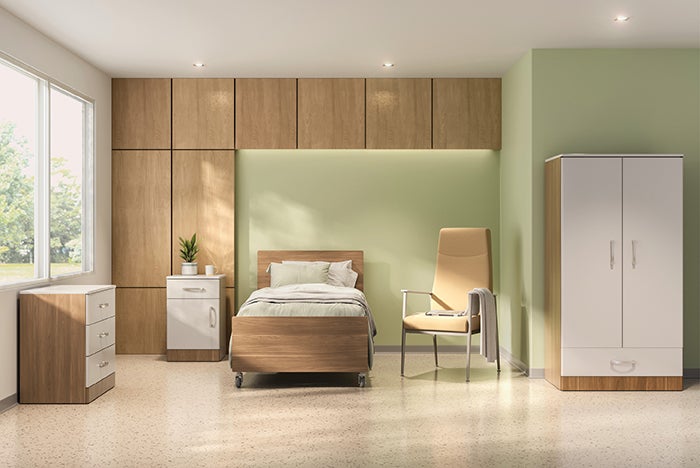
Image courtesy of Stance Healthcare
Furnishings manufacturers are prioritizing the patient experience in their new product introductions, with patient-centered design now a fundamental principle supporting healing, dignity and comfort.
Additionally, more furnishings are hospitality-inspired. This means ergonomically supportive furniture for caregivers and patients — universal, modular designs that support a wide range of users, body types and mobility without stigmatization. Sustainability, replaceable components and serviceability are other features.
Manufacturers also incorporate an understanding of trauma in the design process to better support recovery and patient well-being by offering approachable aesthetics, comfort and durability without an institutional feel.
Hospitals continue moving procedures to ambulatory and clinical settings, which increases demand for flexible furniture solutions that support fast patient turnover and multipurpose spaces.
Finally, many health care systems are prioritizing renovations and adaptive reuse. From a furniture perspective, this requires flexible, durable products with smaller footprints.
Furniture facts
Manufacturers are using new materials and designs to meet health care needs, such as infection control, cleanability and bariatrics. This includes nonporous, durable materials with minimal seams to support rigorous disinfecting protocols, as well as welded steel frames, corrosion-resistant coatings, antimicrobial materials and solid-surface options for tables.
Additionally, high-load seating options include chairs tested to 400 pounds and bariatric models tested to 600 pounds. Safe design details include overhang arm caps for assisted ingress and egress, and wall-saver legs that protect surfaces.
Among furniture products, Herman Miller in Zeeland, Mich., introduced the Gemma Seating Family suite of recliners and sleep solutions. They feature intuitive, one-step transitions from sitting to sleeping, multiple recliner button placement options for different mobility levels, and integrated push-bars and foldaway arms.
“Equally important is Gemma’s scalability. With recliners in three sizes — a sleep chair, a flop sofa available in multiple widths and a double sleep sofa — facilities can create a cohesive experience across patient and consult rooms, respite areas and waiting spaces without compromising on comfort or durability,” says Michelle Ossmann, Ph.D., MSN, MSW, director of research for MillerKnoll Inc., also in Zeeland. Mobility is another advantage. Five-inch casters enable smooth, low-effort movement across clinical surfaces.
Steelcase Health in Grand Rapids, Mich., offers the Apprise Collection of seating and tables designed for the care journey from waiting to exam to family stays. “Soft, contoured cushions, independent back flex and inviting forms help create calming, residential-feeling spaces that put people at ease,” says Dennis Garcia, general manager. “Durable materials, minimal seams, crumb sweeps, replaceable cushions and welded steel frames are built to withstand clinical environments.
“Shared forms across guest seating, lounge seating and tables create a cohesive, scalable aesthetic from one care space to the next,” Garcia adds. “It also features multiple sizes, bariatric options, contrasting upholstery and tables in high-pressure laminate and solid surface. Powered options support productive waiting and long stays.”
Kwalu in Atlanta expanded its Ellie Collection, introducing recliners and sleeper sofas that support patients and caregivers. These additions are designed to enhance comfort, flexibility and functionality within patient rooms and family spaces, recognizing that healing environments must accommodate not only patients but also loved ones and caregivers.
“Featuring Kwalu’s proprietary Protea finish, these pieces combine the warmth and visual appeal of wood with the performance required in hospitals, including durability and antimicrobial properties,” says Jennifer Adams, senior vice president of sales. “This allows designers to create welcoming, residential-inspired spaces that maintain the rigorous standards required in health care environments.”
The latest IOA Cama Collection patient care chair, a collaboration between IOA Healthcare Furniture in Thomasville, N.C., and Cama Inc. in New Haven, Conn., was developed in response to research by Johns Hopkins promoting patient mobility, says Cama Inc. President Rosalyn Cama, FASID, NCIDQ, EDAC. “This understanding moves patients from bed-centric or chair-centric immobility to activate the transformational healing one needs to stay active,” Cama says. “Mobility programs are growing and have been shown to decrease falls, decrease lengths of stay, promote home discharges and lower 30-day readmission rates.”
IOA Healthcare Furniture and Cama are sharing their analysis of this shift through a continuing education unit called The Healing Power of Mobility.
Allseating in Mississauga, Ontario, offers multiuse seating that can be used in patient rooms, family zones, staff areas and waiting rooms. To expand its design appeal and versatility in health care training and lounge settings, the company introduced new frame finishes for Rainbow in black, matte bronze and matte smoke. A silver finish matching the Rühe and Foster collections also is available. “Rainbow is a bright solution for institutional and health care environments, with three seat sizes, two base options and a square back design,” says Stephanie Smith, marketing director.
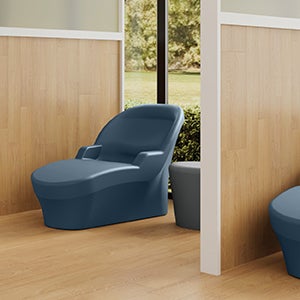
Norix Furniture in West Chicago, Ill., introduced the Respite lounge chair, which utilizes trauma-informed design principles to provide a calming and secure seating solution for behavioral health care and crisis care environments. Its gentle recline and lumbar support are ergonomically engineered to offer sustained comfort even during extended use.
Norix Furniture also introduced the Ripple modular seating series, which utilizes a blend of comfort, durability and neuro-aesthetic design elements to promote a positive emotional and psychological experience. “Ripple’s soft lines bring a gentle, humanizing touch to institutional environments without sacrificing safety or long-term durability,” says Jamie La Montagna, director of marketing.
Cortech in Willowbrook, Ill., offers the Sequoia Series of furniture, which combines the warmth of residential wood aesthetics with the performance required for behavioral health and other high-acuity environments. Each piece is formed as a single, seamless unit, improving durability while reducing maintenance concerns. The series also includes a wardrobe with an optional staff-accessible locking compartment to secure storage. “Sequoia is designed to support patient dignity and staff workflows,” says Kevin Claffy, who manages strategic sales and customer success. “The collection incorporates smooth transitions and ligature-resistant features, while delivering the look of real, assembled wood.”
For administrative spaces, KI in Green Bay, Wis., offers the Passel furniture solution, which is well-suited for a range of health care environments. “As a desk system, it’s easy to plan and implement for administrative staff in medical office buildings and other workstation settings,” says Jonathan Webb, LEED AP, director for workplace and health care. “Its intuitive, beam-based design also supports educational and training spaces for staff, offering flexibility as needs evolve. With simple, adaptable power and technology integration, Passel accommodates a range of tools and workflows to enhance administrative care spaces.”
Cabinetry changes
Cabinetry is moving toward warmer finishes and away from stark white tones, with popular choices centered on brown woodgrains that create a natural, inviting aesthetic, according to Rachel Chappie, marketing manager at Midmark Corp. in Versailles, Ohio. “Overall, health care color palettes continue to be influenced by organic, golden hues designed to foster a warm and welcoming environment for patient care,” Chappie notes.
Midmark offers Synthesis wall-hung cabinetry, which enhances ergonomic reach and visibility to help reduce stress and strain injuries while supporting storage efficiency and infection prevention practices. “By elevating cabinetry off the floor, wall-hung designs eliminate hard-to-clean areas where dust and pathogens can accumulate. Also, durable steel-on-steel construction withstands the rigorous disinfection protocols required in clinical environments,” Chappie says.
Midmark cabinetry also accommodates varying room sizes, equipment needs and mobility devices used by patients and staff. “Because health care workers face disproportionately high rates of workplace injuries, cabinetry that minimizes bending, twisting and searching for supplies is essential,” Chappie says. “Synthesis wall-hung cabinetry is engineered to support better posture and workflow efficiency. Its configurable designs and gravity-fed, angled flow shelving improve visibility and access to supplies, even those stored at the rear.”
Stance Healthcare in Kitchener, Ontario, introduced the Camber series of case goods, which offers sleek, convenient storage in multiple bedside table and wardrobe sizes for patient rooms. “All cabinets feature three-fourth-inch backs in matching laminate, seamless tops and contrasting fronts, and steel drawer boxes for increased durability,” says Tracey Heimpel, national sales director. Options include a solid-surface top, black or brushed nickel pulls, and a choice of single-finish or two-tone in white or gray for its vinyl laminate front.
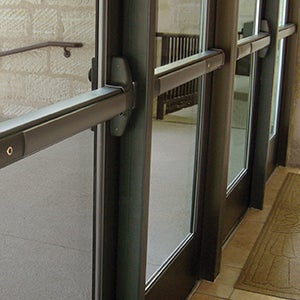
Spec Furniture Inc. in Toronto offers Hardi tables, which combine a seamless, roto-molded base with a structural top plate and a high-pressure laminate work surface. This provides impact resistance, easy cleanability and reliable performance in demanding health care and behavioral care environments, the company states. Hardware is largely concealed, with exposed fasteners limited to tamper-resistant, countersunk connections at the work surface. A concealed floor-mounting system improves security by preventing access after installation.
Textile trends
In the area of textiles, there is a shift toward inherently durable materials that achieve performance through construction and yarn technology, according to Heather Bush, chief creative officer at Carnegie in Rockville Centre, N.Y. “Materials can offer bleach cleanability without added surface treatments, while solution-dyed yarns ensure colorfastness and long-term durability,” Bush explains.
Carnegie introduced Eden upholstery textiles, which are suitable for health care furnishings and designed to support infection control, durability and human comfort. “At the center of this offering is Xorel Luxe, a plant-based upholstery engineered for demanding hospital environments,” Bush says. It can be cleaned with water, solvent cleaners, diluted bleach and many other disinfectants. The Eden upholstery range also includes textured and nature-inspired patterns that allow designers to add warmth and biophilic cues into hospital settings.
Aesthetically, Sara Balderi, executive design director at Designtex in New York City, sees a shift away from overly clinical designs toward soft surfaces, like textiles with more warmth, tactility and visual softness. “We see increased interest in calming colors, subtle patterns and materials that bring in a greater sense of comfort and humanity,” Balderi says.
Designtex is developing health care performance textiles that combine a more refined, human-centered aesthetic with the durability and cleanability that health care environments require. A key part is the exploration of bio-based coated textile platforms and other lower-impact material solutions.
“The goal is to create products that not only support demanding hospital applications but also align with broader sustainability goals,” Balderi says. Key features include high durability and ease of maintenance paired with more elevated color, texture and material nuance.
Evolving care, changing needs
Looking ahead, there will be greater emphasis on adaptable, reconfigurable furniture solutions that can support evolving care models and changing patient needs, predicts Smith at Allseating.
“As facilities shift toward outpatient care and more specialized environments, furniture will need to balance durability, cleanability and ergonomic support with a more welcoming, hospitality- and residential-inspired aesthetic,” Smith says. “There also is growing interest in integrating smart features and serviceable components that extend product lifespan and improve long-term flexibility.”
Webb at KI sees more intelligent furniture on the way. “These products will increasingly integrate sensors, power and connectivity that support clinical workflows and provide useful data — things like patient presence, utilization rates or caregiver ergonomics,” Webb says.
THOROUGHLY MODERN
The Camber case goods collection is designed with contrasting tops and fronts for a clean, contemporary look. Stance Healthcare
CARE CONTINUUM
The Apprise Collection of seating and tables is designed for the full care journey — from waiting to exams to extended family stays. Steelcase Health
EASE OF USE
Synthesis wall-hung cabinetry is engineered to support ergonomic reach and workflow efficiency. Midmark Corp.
TOUGH ENOUGH
Hardi tables feature a material composition that provides impact resistance and easy cleanability. Spec Furniture Inc.
REST AND RELAX
The Respite chair’s gentle recline is ergonomically engineered to offer sustained comfort even during extended use. Norix Furniture
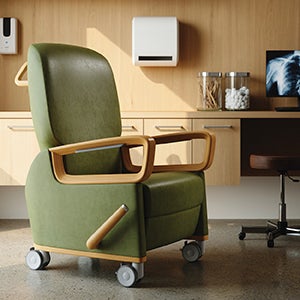
DESIGNED FOR COMFORT
The Ellie recliner integrates intuitive, biophilic and neuro-aesthetic design principles to support movement and comfort. Kwalu
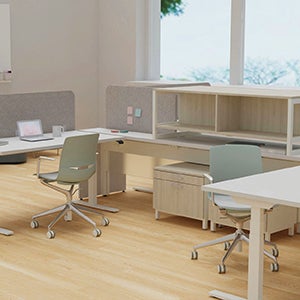
IMPROVED EFFICIENCY
The Passel desk system features simple, adaptable power and technology integration and accommodates a range of tools and workflows. KI
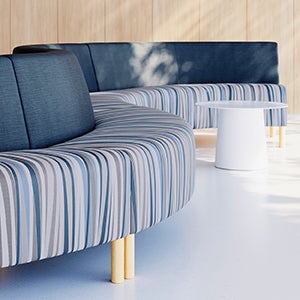
SOOTHING TEXTILES
Terrene and Mote layered tactile and visual textures create environments that feel calm, human and restorative. Designtex
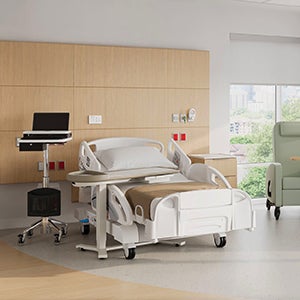
ENVIRONMENTAL ENGINEERING
The Gemma Seating Family of recliners and sleep solutions makes care environments supportive and human-centered. Herman Miller
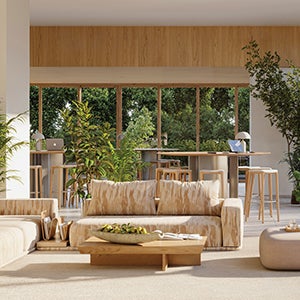
FABULOUS FABRICS
Eden upholstery textiles are designed to support infection control, durability and human comfort. Carnegie
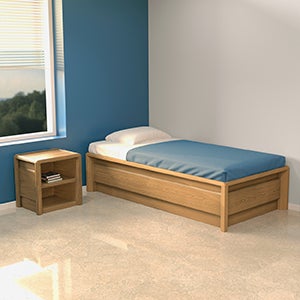
STRONG AND WARM
The Sequoia series features molded, seamless construction and brings a residential wood look to behavioral health environments. Cortech
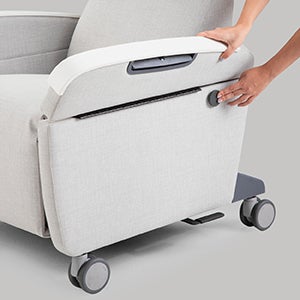
OPTIONS GALORE
The Cama Collection patient care chair offers accessories such as adjustable, foldaway arms and footrests that ease clinical and therapeutic practices. Cama Inc.
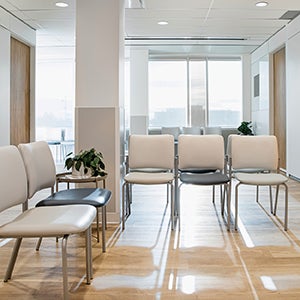
FANCY FINISHES
The Rainbow furniture collection features new frame finishes in silver, black, matte bronze and matte smoke. Allseating
Neal Lorenzi is a Mundelein, Ill.-based contributor to Health Facilities Management.
Product inclusion in this article should not be construed as an endorsement by Health Facilities Management, ASHE or the American Hospital Association.
Related Articles
Cleaning and waste management solutions
Patient mattress recycling, laundry management and ligature-resistant waste solutions for health care facilities.

Four product innovations for health facilities operations
Four products for health care facilities, including environmental monitoring and parking technology.
Solutions for navigating health care facilities
Four products for signage, wayfinding and digital communications in health care facilities.