

Making sense of health care sensory rooms
A multisensory or “Snoezelen” room can be used to decrease stress and support well-being in the health care environment. Three papers from The Center for Health Design’s Knowledge Repository illustrate select outcomes associated with these types of rooms.
A research team led by Lahera examined whether projecting stars onto dark ceilings and walls (i.e., starlight therapy) would reduce anxiety in female breast cancer patients prior to their first chemotherapy treatment. The study team painted a consultation room dark blue, installed blackout shades to windows and doors, and furnished a recliner.
On the first day of chemotherapy treatment, data was collected before and after the patient met with their provider, after 15 minutes of starlight therapy and after completing treatment. Data collection included a five-item survey, three open-ended questions, and heart rate and blood pressure assessments. Of the 30 patients who began the study, 29 completed all elements. Perceptions of the intervention were overwhelmingly positive, with the greatest decrease in anxiety occurring after the starlight therapy. Suggestions to improve the sensory intervention included adding soft music, celestial sounds or white noise.
Martin and Kertechian recruited health care staff from different French facilities to participate. Participants first attended training about multisensory environments, then small groups engaged in three, 30-minute multisensory room sessions over two days. The room featured a bubble tube, waterbed, light projector, fiber optic lights, tactile objects, soft music and an aromatherapy diffuser.
Researchers interviewed participants after the intervention and identified four themes. Staff perceived the room as relaxing, a source of calm promoting emotional regulation, a source of calm fostering revitalization and an opportunity to reflect. The overwhelmingly positive reception of the multisensory room suggests its use as part of a holistic approach to health care staff well-being.
A study by Dawson and colleagues took place in an eight-bed psychiatric intensive care unit that provides short-term care to adults with acute psychosis, mood, anxiety or personality disorders. A multisensory room fitted with an integrated sound, visual and lighting system and vibroacoustic furniture was implemented in an office outside the unit.
Medication and seclusion rates for behavioral issues were recorded before room implementation and afterward at 10 and 17 months. Medication use didn’t differ after implementation, but there was a non-significant decrease in seclusion. Researchers also interviewed both staff and patients who had used the room.
Interviews revealed most barriers to room utilization were staff-related (i.e., unfamiliarity with the strategy and benefits, not knowing how to use the technology and the need for two nurses to accompany patients). Facilitators to room utilization included staff familiarity and belief in the multisensory strategy and comfort with the technology. Future considerations might include multisensory rooms with direct sight lines for staff or adding sensory features in commonly used areas.
Each of these studies employed sensory elements demonstrating potential benefits of these types of environments. Incorporating multisensory features can be inexpensively implemented and customized for specific populations. You can find more articles on multisensory environments and other health care design topics in The Center for Health Design’s Knowledge Repository.
Research used for this column
The following research citations from The Center for Health Design’s Knowledge Repository of health care design resources were used by the author when writing this column:
- A. Lahera et al., “Starlight Therapy: Reduction of Anxiety in Women with Breast Cancer Receiving First-Time Treatment,” Clinical Journal of Oncology Nursing, vol. 30, no. 1 (2026).
- P. Martin and K. S. Kertechian, “Managing Stress among Healthcare Professionals: Insights from the Snoezelen Approach,” Journal of Health Organization and Management, 2025, in press.
- S. Dawson et al., “Implementation of a Sensory Room in a Psychiatric Intensive Care Unit: A Mixed-methods Study,” International Journal of Mental Health Nursing, vol. 34, no. 4 (2025).
About this column
“Design Discoveries” highlights research from The Center for Health Design’s Knowledge Repository, a user-friendly library of healthcare design resources. This research effort is supported by the American Society for Health Care Engineering, the American Institute of Architects, the Academy of Architecture for Health Foundation and the Facility Guidelines Institute.
Yolanda Keys, Ph.D., R.N., EDAC, research associate, The Center for Health Design.
Related Articles
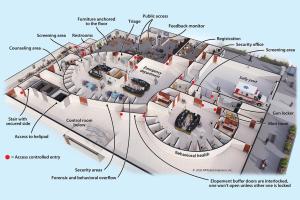
Designing for safety in health care facilities
An overview of the International Association for Healthcare Security and Safety's design guidelines to protect patients, visitors and staff.
ED expansion plans will advance care, enhance flow
Renovation will bolster capacity for the Baton Rouge, La.-area Level 1 trauma center.
Planning care spaces for daylight and views
New entries in The Center for Health Design's Knowledge Repository further the case for windows in patient care rooms.