

New system brings proton therapy to smaller facilities
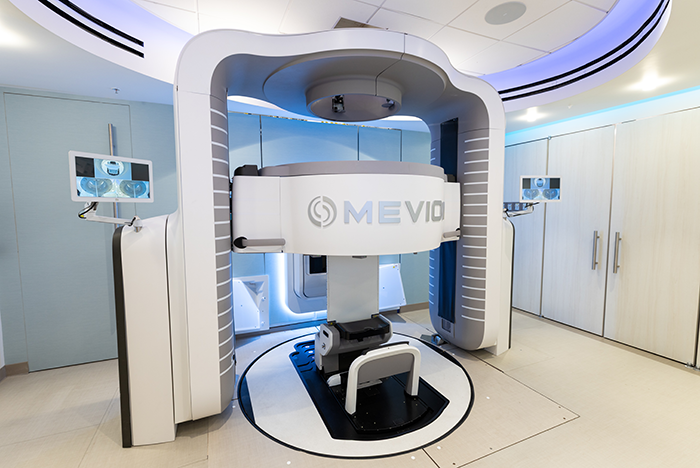
The Mevion S250-FIT proton therapy system allows Stanford Medicine to deliver life-saving care in a smaller footprint.
Image credit: Steve Fisch/Stanford Medicine
Proton therapy for cancer treatment recently became much more accessible with the introduction of a new system that can fit into a standard-sized radiation vault.
Earlier this month, Stanford Medicine Cancer Center in Palo Alto, Calif., cut the ribbon on a new proton therapy center for pediatric and adult cancer patients. The targeted treatment, which can deliver radiation precisely to a tumor with minimal damage to surrounding healthy tissues, has been around since the 1950s. However, the large size of traditional proton therapy systems made it difficult for many organizations to offer this treatment. Proton therapy typically would require constructing a brand-new facility half the size of a basketball court and in some cases the size of a football field depending on the system’s dimensions.
Stanford Medicine set out to change that and introduced a groundbreaking new system that can fit into an existing radiation vault.
The health care organization collaborated with two medical technology companies to find a way to shrink the size and reduce the cost of proton therapy systems without minimizing their effectiveness by rethinking the way the care was delivered. With traditional systems, proton therapy is delivered in a multistory facility where a cyclotron rotates on a gantry around the patient. While the patient lies flat, the machine moves one story above or below the patient to deliver treatment.
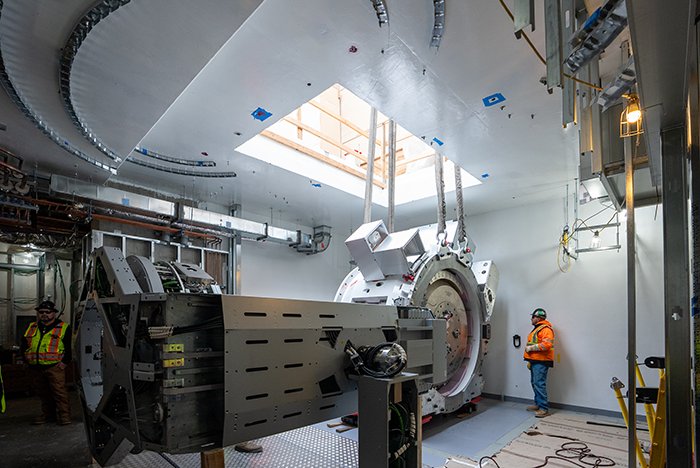
The construction team installed the new system in Stanford Medicine's existing radiation vault.
Image credit: Stanford Medicine
With this new system, however, the system stays in a fixed position while the patient sits upright in a rotating chair that moves them around the machine instead of the other way around. Stanford Medicine collaborated with Mevion Medical Systems, Littleton, Mass., which offers the most compact cyclotron on the market, and Leo Cancer Care Inc., Middleton, Wis., which developed a space-saving system using upright rotating treatment chairs.
“Once we brought the companies together, the light bulbs went on,” says Billy Loo, M.D., Ph.D., professor of radiation oncology and co-director of particle therapy at Stanford Medicine. “They said, ‘OK, we will make this product,’ and Stanford Medicine agreed to be the first customer.”
The two companies set out to combine the world’s smallest cyclotron and the rotating chair to decrease the amount of space need to deliver proton therapy. The equipment fits into a standard 1,200-square-foot linear accelerator vault, which allowed Stanford Medicine to install the new system in its existing radiotherapy department instead of having to build a new facility. Loo says the team used a best practice simulation to model the proportion of dose leaking out of the vault for a given level of treatment and determined that the vault shielding in its existing facility was adequate to safely operate the new system.
Stanford Medicine is the first hospital to bring the Mevion S250-FIT proton therapy facility to life, but more are already in the works. Loo reports that nine other medical centers around the world are currently working to install the new system at their facilities.
Related Articles

NFPA weekly update: Oct. 12-16
The National Fire Protection Association issued a tentative interim amendment to the Life Safety Code regarding noncombustible materials.
NFPA weekly update: Sept. 28 to Oct. 2
A tentative interim amendment to NFPA 99, Health Care Facilities Code, on medical gas piping is open for public comment.

Healthcare may hold the key to long-duration energy storage adoption
Reflections from a healthcare perspective on the Long Duration Energy Storage Summit and the need for resilience and reliability.