

Optimizing healthcare infrastructure through enterprise asset management

Technician's at Montefiore Einstein's Moses Campus report better workflow efficiency since implementing the a systemwide enterprise asset management solution.
Image courtesy of Montefiore Einstein
“This program is long overdue,” said an engineering technician at the Montefiore Einstein Moses Campus, located in the Bronx in New York City, about the health system’s enterprise asset management (EAM) implementation.
“I feel the organization this system provides will increase workflow due to its direct access of communication between management and the shops [e.g., carpentry; plumbing; and heating, ventilating and air-conditioning (HVAC)].”
His sentiments reflect the significance of implementing a standardized system that enhances consistency and efficiency across facilities operations.
Montefiore Einstein unified engineering, clinical engineering, fleet and radiation safety assets into a cloud-based EAM system paired with 3D building information modeling (BIM) to characterize facilities. The multiyear effort produced a digital transformation of facilities across the health system and resulted in readily accessible location data and architectural layouts matched to assets.
Following the implementation, a single source of truth is now available for Montefiore Einstein’s building spaces and assets. Tangible benefits have already been realized and continue to grow, including improved readiness for regulatory review, enhanced patient safety through reduced asset downtime, and lower overall facility and maintenance costs.
The complex journey to transformation
Montefiore Einstein is a leading academic health system serving communities across the Bronx, Westchester, Hudson Valley and the broader New York City metropolitan region. Its state-of-the-art facilities reflect a deep commitment to accessible, world-renowned care.
With a reach that extends across multiple counties and a mission to heal, teach and discover and advance the health of the communities it serves, Montefiore Einstein continues to shape the future of academic medicine.
With such a vast healthcare system, there were challenges in achieving operational excellence. Montefiore Einstein had 38 disparate EAM systems across 13 locations (12 hospitals and one university). Some departments and locations maintained paper-based records, while others used various tools such as Microsoft Excel or other computer systems.
For example, within the engineering department at the Moses Campus, 2,000 pieces of paper were previously distributed to technicians and staff members each month to complete work orders and maintenance for the facility. A systemwide inventory of campus assets did not exist. Manual processes were used to record completion of work orders, and substantial effort was spent on locating assets and preparing documentation for regulatory reporting. In most cases, clinical personnel would call the department to request maintenance or service. The disconnection and inaccuracies of this fragmented approach hampered the health system’s ability to provide accurate asset counts; real-time management of assets; asset replacement based on end-of-life; and timely digital reporting for its leadership, administration and clinical personnel.
A unified solution to a disparate challenge
After careful consideration and benchmarking of EAM tools used by Montefiore Einstein and other United States-based hospitals, the health system selected a cloud-based tool to streamline asset management processes. The Montefiore Einstein EAM program transitioned more than 1,000 end users to the new standard, unified solution accessible on the go from their company-issued iPad or mobile device. The solution also includes a simple, one-page web form for clinical personnel to request maintenance or service from the applicable department.
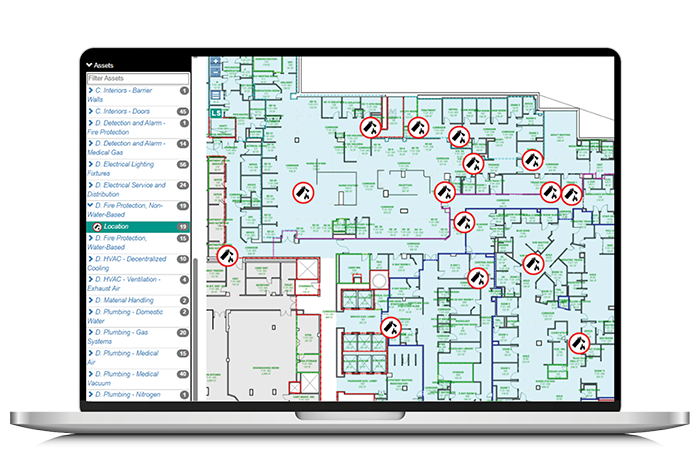
The space management tool enables smarter space management and improved inspection, testing and maintenance planning.
Image courtesy of Montefiore Einstein
The team started the initiative by standardizing the naming convention for asset classes and categories. This step was informed by data standards developed by FGI and the American Society for Health Care Engineering (ASHE). Work order categories and priorities also were established, driven by common problems that carry specific templates for work order resolutions. These categories describe the various incidents that commonly occur in the affected departments. The system enables the team to conduct root-cause analysis for work orders, empowering greater awareness and risk avoidance.
Within the standardization process, assets also were designated a risk classification and asset criticality classification in compliance with Joint Commission and the asset risk categorization recommendations found in the National Fire Protection Association’s NFPA 99, Health Care Facilities Code.
A library of inspection, testing and maintenance (ITM) plans was then created to align and reference applicable codes for all authorities having jurisdiction, where applicable, enabling regulatory compliance. These plans outline the procedures that technicians follow when performing preventive maintenance, ensuring that assets are maintained at a predetermined frequency aligned with leading industry standards. The plans also contain the documentation details of the work performed, the date it was performed and the status of the asset, making details readily available for compliance reviews.
In some cases, ITM plans also were customized to local regulations, allowing each Montefiore Einstein location to have site-specific plans.
In addition to regulatory compliance, the ITM library facilitates swift and nimble reaction to any changes made to regulatory standards. Changes are applied to a shared library across 13 sites available in the EAM system and rapidly deployed to all entities and end users. Recently, this shared library proved indispensable to quickly apply changes to procedures based on Joint Commission’s updated accreditation program.
To ensure an accurate inventory baseline of engineering assets, Montefiore Einstein partnered with a vendor to tag engineering assets with QR codes and enter key asset information into the new EAM system. This information includes details such as manufacturer, serial number, model number, asset description and location. Examples of engineering assets integrated into the system include:
- HVAC units
- Generators
- Fire safety systems
- Elevators
- Exit signage
Examples of clinical engineering assets integrated into the system include:
- Defibrillators
- Infusion pumps
- Patient monitors
- Ultrasound machines
- CT machines
- MRI machines
- Ventilators
- Patient lifts
Given the scale of the initiative, understanding existing data and defining a plan to migrate and transform historical data from legacy systems was central to making the new system operational, particularly for clinical engineering. The team evaluated existing EAM data at each Montefiore site and determined a mapping approach. There was an extensive period of data migration that occurred for the clinical engineering and fleet departments.
In addition, extensive transformation work and data quality assurance was completed for clinical engineering assets to integrate the data into the EAM system, enabling standardization across the different facilities and ensuring the removal of obsolete data. The data had to be refined by correcting or removing duplicate attributes and cleaning up free-text fields, asset categories, locations, manufacturers, status attributes, field configurations, procedures, procedure schedules, user/resource lists, data reports, dashboards and more. Alternatively, the engineering department started with a paper-based system and a limited set of historical asset data to feed into the EAM initiative. Going forward, the EAM team will continue partnering with engineering to expand the standard asset history.
Because each entity performed their maintenance programs differently prior to the initiative, the team worked in cross-entity groups to design the new standard business processes for asset creation, work order creation, service request responses, corrective maintenance, asset procurement and report generation. The team designed report prototypes based on the key metrics that are most beneficial for understanding the state of predictive and corrective maintenance not only for each department but also on a cross-entity basis.
Building a digital twin
The EAM team also partnered with vendors to integrate a space management tool, creating an accurate characterization of 13 locations across Montefiore Einstein by capturing the geometry of facilities and important spatial metadata through automated 3D BIM. From the exterior to the interior of the building, all spaces were scanned to encompass the entire footprint, including assets located on the roof.
Prior to this initiative, Montefiore Einstein’s BIM provided a structured approach to organizing only necessary architectural building information, such as core model components like walls; doors and windows; stairs; and elevator cores, shafts and rooms. For some spaces, the model expanded to include additional components, such as sinks, workstations, nurse stations, counters and other fixed features, to reflect the enhanced level of detail needed for planning, design, construction and operations. By conducting a thorough 3D capture of spaces, Montefiore Einstein now has a digital twin, making space and asset location data and architectural layouts accessible by departments across the health system.
Within this process, room types were standardized to the FGI Guidelines to unify how spaces are organized within the space management program. This standardization effort required months of collaboration, ensuring that standardization could be achieved for spaces and rooms throughout the building, including areas like:
- Elevators
- Elevator lobbies
- Stairs
- Nurse stations
- Patient rooms
- Patient toilets
The digital foundation and environmental intelligence of the complementary EAM tools enable the enterprise to leverage space data from sites, buildings, floors and rooms, with assets tagged and mapped for each location on 2D floor plans. From there, assets are linked to maintenance procedures or ITM plans according to asset category (and in some cases asset model) and scheduled for weekly, monthly, quarterly or yearly inspections.
The space management tool enables smarter management of spaces, such as allowing users to navigate spaces virtually, download up-to-date architectural drawings and measure square footage of a room. Users also have access to panoramic, 360-degree virtual views of the spaces and rooms at their location.
Value delivered through EAM
Through the EAM program and solution, Montefiore Einstein achieved:
- Nearly 8.7 million square feet of hospital space scanned and characterized — equivalent to 3.24 Empire State Buildings;
- More than 68,715 engineering and fleet assets tagged at each entity with QR codes;
- More than 175,000 total assets now managed within the system;
- More than 2 million historical work orders standardized, transformed and migrated for access and informed decision-making;
- More than 67,980 new service requests added to the EAM system;
- Roughly 21,910 new work orders added to the EAM system; and
- 136,500 ITM plans scheduled with code references to ensure compliance.
The hospital system achieved major improvements in data accuracy and visibility, resulting in fewer outages and stronger, data-driven decision-making. The project also won measurable cost savings of $9 million annually by avoiding local penalty fees for surpassing greenhouse gas emissions caps.
As part of the project, the team recalculated and reanalyzed the square footage of Montefiore Einstein’s Moses campus. Based on this analysis, the energy and sustainability team was able to update its reportable square footage, which was 28% greater than what was previously accounted for due to outdated and inaccurate paper-based floor plans and nonstandardized lists that lacked an accurate count of assets. The reportable square footage is used as the denominator to calculate a facility’s energy use intensity. Under New York City’s Local Law 97, facilities that surpass locally mandated greenhouse gas emissions caps incur fees. With its reportable square footage now accurate and up to date, the Moses campus saw a reduction of penalties from Local Law 97. Similarly, calculations were completed for the Albert Einstein College of Medicine, located in the Bronx, resulting in reduced penalties there as well. Through the EAM tools, the energy and sustainability team maintains improved readiness for New York City Department of Buildings audits and can develop more informed and sophisticated energy efficiency recommendations and decarbonization plans.
Having access to its accurate, real-time asset count and information within the office and in the field enabled the organization to achieve operational excellence, right-size its team in the areas needed and create efficiencies through its new mobile workforce. Technicians complete work orders via iPads, enhancing workflows and improving timely service delivery. Subsequently, coordinators, managers and leaders can access the digital system to track performance, manage work and analyze work order completion metrics.
Reduced time and effort, combined with improved accuracy, have contributed to employee satisfaction as well. Of the employees who responded to a survey, more than 80% reported satisfaction with the new system. In addition, nearly 75% said the new EAM tools improved readiness for regulatory review.
Overall, the EAM solution enabled standardization, governance and adoption of digital tools for the Montefiore Einstein health system.
A bright future ahead for EAM
With the implementation of EAM complete across the health system, the EAM team at Montefiore Einstein has transitioned to run-mode operations.
With the continued leadership of Christine Hillman, director of EAM at Montefiore Einstein, the team is focused on empowering the EAM community with the data to make informed decisions while positioning the organization for further cost savings, continued regulatory compliance, contributions to the capital planning process and additional system integrations. With the foundation established for a holistic EAM life cycle, the team is actively driving increased asset management maturity across the health system.
“It’s just the beginning for us here,” Hillman says. “We have a small but incredibly mighty team, and because of the baseline we’ve established, we are positioned to future-proof our work to continue adapting, improving and expanding. We are committed to delivering safer, smarter patient care across Montefiore Einstein through our evergreen EAM system.”
Learn more
As demonstrated by the Montefiore Einstein EAM program, effective asset management is essential to delivering safe, high quality and cost-efficient care in today’s complex hospital environment. Read more about how EAM systems strengthen operational reliability, regulatory compliance and organizational resilience in a new white paper by Montefiore Einstein.
The white paper also covers emerging trends shaping the next generation of EAM to advance operational performance and patient care.
Related article // Enterprise asset management system helps students find their way
Montefiore Einstein’s enterprise asset management solution has been successfully extended to additional use cases, delivering expanded value to the New York-based health system.
For example, the reality capture baseline was used to develop a wayfinding resource for roughly 800 students at Albert Einstein College of Medicine, located in the Bronx in New York City. Students can use the digital mapping tool, Einstein Explorer, to quickly and easily locate spaces across the campus from their mobile device.
Prior to this wayfinding tool, the college was looking to avoid risks of citation, as location knowledge is a higher education accreditation requirement. The tool ensures that medical students can easily find classrooms, study spaces, lockers, patient care areas and wellness spaces at the medical school and affiliates. Through the Einstein Explorer wayfinding resource, the following value has been achieved:
- Improved student experience. Medical students save time and can focus on studying or completing other tasks, instead of searching for a classroom, storage area, clinical space or wellness space.
- Reduction in service time. Clerkship directors no longer need to ensure medical students are briefed on where to go at all clerkship and acting internship orientations.
- Risk avoidance. The wayfinding tool ensures ongoing compliance with accreditation standards and risk management.
Christine Hillman, is the director of enterprise asset management at Montefiore Einstein. She can be reached at EAM@montefiore.org.
Other article contributors include Elise Ghebremichael and Sophia Anderson of Leader in Change Consulting.
Related Articles

Nuvolo launches regulatory compliance management to tie survey readiness directly to maintenance work
New capability maps regulatory standards to assets so healthcare organizations can build compliance evidence as work gets done.

Security ecosystem helps manage risk
City of Hope partnered with Motorola Solutions to developed a layered security strategy for its 100-acre California campus.
Healthcare proposals help shape 2027 I-Codes
With the 2027 International Code Council code cycle complete, here’s a review of successful changes advocated for by the Committee on Healthcare.