

A recap of the 2026 Health Care Facilities Innovation Conference
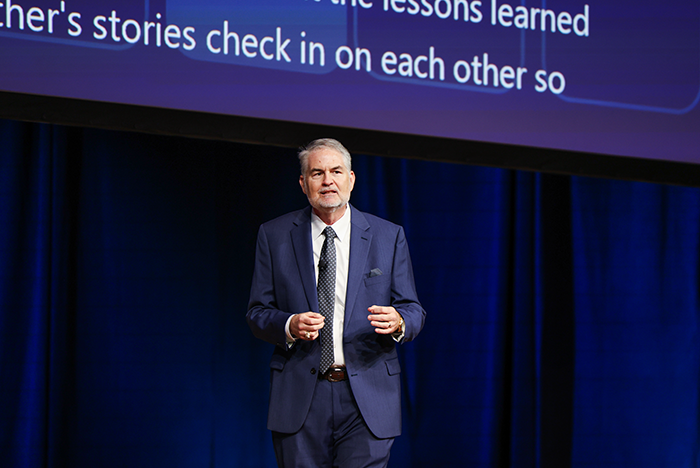
ASHE President Dennis Ford kicked off the 2026 Health Facilities Innovation Conference®.
Image courtesy of ASHE
The American Society for Health Care Engineering (ASHE) has always been about its members and the facilities and communities they serve, said ASHE President Dennis Ford, MHA, CHFM, CHC, FASHE, in his opening remarks to the Health Care Facilities Innovation Conference®, on Aug. 2-5 in Minneapolis. "We are committed to helping you carry out your duties as effectively and efficiently as possible and representing the interests of the physical environment in every aspect of healthcare," he added.
Toward that end, ASHE attracted more than 3,200 attendees to its conference with a host of social events, association meetings and awards presentations, as well as an educational program featuring 180 speakers and 107 sessions on subjects such as emerging codes and standards, new technologies and technical innovations, and management and leadership trends.
Additionally, a packed technical exhibition featured approximately 350 leading solutions providers to demonstrate the impact of technology in advancing innovation in the healthcare facilities field. Finally, ASHE offered a robust program of 11 pre- and post-conference sessions for attendees wishing to expand their experience.
General sessions discuss wide range of topics
A centerpiece of the Health Care Facilities Innovation Conference was its five general sessions, which tackled topics including professional development, risk management, future trends, and healthcare legislation and regulatory affairs.
The opening keynote on Monday morning featured Paul Epstein, an author and former NFL and NBA executive, who spoke on "Making Better Decisions Faster: Overcoming Paralysis and Inspiring Action” in a presentation that centered on the habit of "winning Mondays."
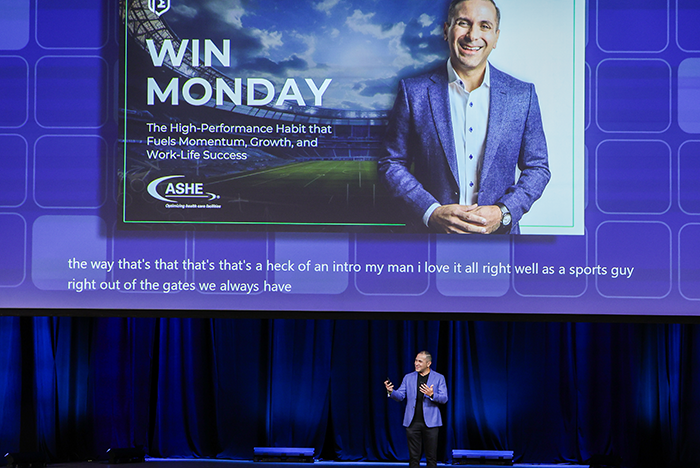
Author and former professional sports executive Paul Epstein delivered a keynote address on how to "win Monday."
Image courtesy of ASHE
Epstein said it was a lesson he learned during his sporting event sales days, when an executive told him and his colleagues that they were wasting 20% of their weeks by underperforming on Mondays, which ultimately meant they were wasting 2 1/2 months a year.
"The way that we can execute on this weekly habit is by deciding to commit to taking a winning action on a Monday," Epstein said. "This is a game of momentum that we're really playing, because [there’s] one thing that people who win Monday do not do — they do not lose Tuesday." In fact, according to research Epstein referenced, more than 98% of respondents said that when they do something meaningful on a Monday, it provides momentum for the entire week.
To take advantage of this, Epstein suggested attendees build a weekly framework that involves planning on Saturday or Sunday, executing on Monday, checking in on Wednesday and reflecting on Friday. Such a program can be adapted for specific situations and work cultures, he said.
After reflecting on how Los Angeles Lakers' legend Kobe Bryant would put in more practice time than his peers to separate from the field, Epstein said, "Let's say we work 50 years over the course of a career. If you consistently win Mondays, you gain a decade on everybody else."
Moving from professional development to risk management, Monday's second general session featured John Riggi, the American Hospital Association's (AHA's) vice president and national advisor for cybersecurity and risk, speaking on "The Healthcare Cyber Threat Landscape: Risk, Impact and Preparedness, and the Race to AI.”
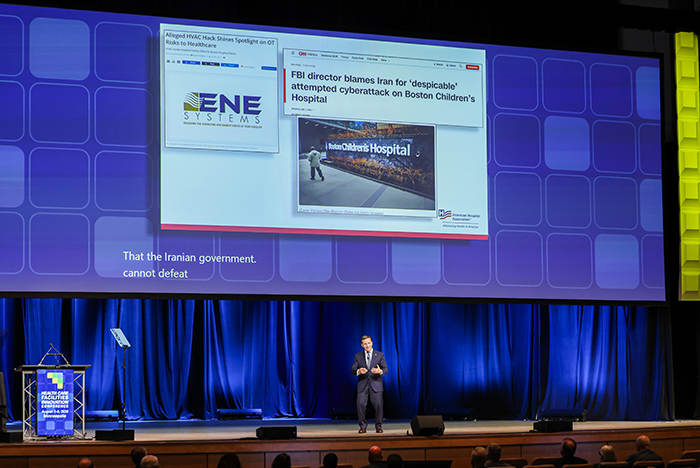
Cybersecurity expert John Riggi reviewed important cybersecurity updates and strategies to protect operational technology from cyber risk.
Image courtesy of ASHE
Noting the vast amount of healthcare facilities operational technology (OT) currently in use, Riggi said, "It improves efficiencies, but we have inadvertently created a great deal of cyber risk."
These risks include new technologies that come insecure by default, requiring continual updates; technologies that are connected to internal networks and the internet, expanding their vulnerabilities; and the field's dependency on these technologies, which has led to a decrease in professionals who can manually operate facilities systems during a cyber event.
Impacts from reported ransomware attacks on hospitals from 2020 through 2026 included several OT systems going offline or down, including building automation systems; life safety and security systems; closed circuit television, radio communications, parking lot and traffic control systems; pneumatic tube systems; and nurse call systems, among others.
After relating information on recent public water system incursions and a previous, foiled cyber-incursion into a children's hospital through a network-connected heating, ventilating and air-conditioning system vendor, Riggi cautioned attendees to think about their third-party partners — who may provide an access point for attackers — as well as other network access points.
He also recommended close collaboration with hospital cyber-security teams, issuing cybersecurity requirements for OT vendors and conducting OT risk assessments, among other measures.
Tuesday morning kicked off with a session looking into the near future from various hospital departmental perspectives, called "Back to the Future: 2030 Health Care Edition." Moderated by Lizzie Ortolano, ASHE's executive director, the session featured panelists culled from the membership ranks of the AHA's professional membership groups.
A key topic during the multidisciplinary discussion naturally centered on how traditionally separate healthcare functions can work together.
"Where the supply chain can add value is we really excel at facilitation," said Tom Harvieux, senior vice president and chief supply chain officer at BJC Health, who represented the AHA's Association for Health Care Resource & Materials Management on the panel. "We take a lot of pride in that we don't own the decision — we own the process of helping people understand what the problem is and what we're trying to do."
"We have broken down silos like never before in healthcare since the pandemic," commented Sarah Bush, MBA, CPHRM, FASHRM, senior director of corporate risk management at Bradford Health Services, who represented AHA's American Society for Health Care Risk Management. "Risk management has a 360-degree view of what's going on in the healthcare organization, and our drive is to continue to knock silos down."

ASHE Executive Director Lizzie Ortolano (left) is joined by a panel of experts in engineering, supply chain, risk management, environmental services and capacity management.
Image courtesy of ASHE
James E. Odom Jr., MBA, CHESP, CMIP, T-CHEST, university director of buildings and grounds, facilities development and operations, at UConn Health, who represented AHA's Association for the Health Care Environment, also mentioned the pandemic effect, stressing that working with supply chain professionals was essential for environmental services (EVS) departments seeking in-demand supplies during COVID-19.
Tackling the topic from a facilities perspective, Dennis Ford represented ASHE on the panel. "We collectively have a common goal and that's to identify and mitigate risk from the physical environment to patients and staff," he said. "So that immediately takes me to risk management because I think we would really like to look at the data to make sure we're concentrated and focused on the right areas.
"From a supply chain perspective, we're always interested in life-cycle cost analysis," Ford continued. "And, from EVS, [we benefit from] the clean environment and [them] protecting the patient. They're also our eyes and ears in the facility because they're out there every day."
Roy Boland, R.N., MSN, MHA, DNP candidate, vice president of consulting, clinical efficiency, at Kaufman Hall, also was on the panel, representing AHA's Hospital Capacity Management Consortium.
Other topics covered during the session included operational changes for off-site facilities, opportunities for greater efficiencies and optimization, and workforce issues, among others.
Tuesday afternoon featured an overview of national political trends as they apply to healthcare facilities, titled "Washington Update: What Happens in D.C. Matters to You.”
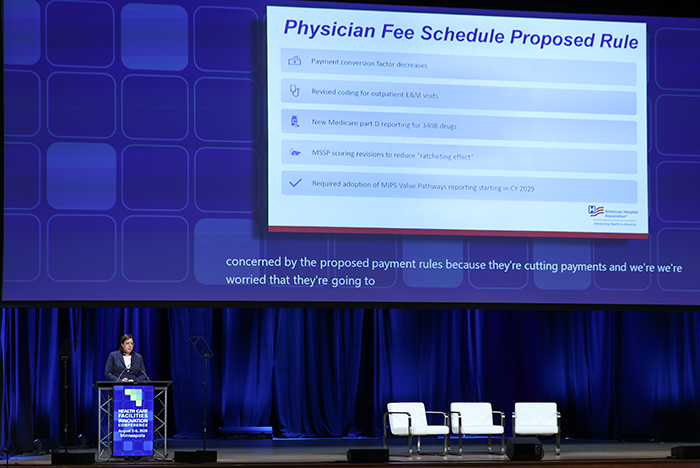
The conference featured an AHA update focused on national political trends and their impact on healthcare.
Image courtesy of ASHE
Featuring AHA's Adrienne Thomas, senior associate director for standards and care delivery, and Ted Sacasa, senior associate director of federal relations, the session walked attendees through the current political environment to discuss key bills and current legislative activity that will potentially impact hospitals in the short and long term.
They also discussed current AHA advocacy efforts and the upcoming election.
Finally, the Health Care Facilities Innovation Conference's general sessions concluded on Wednesday morning with the popular "Just Ask ASHE" session, featuring ASHE codes and standards experts discussing emerging regulatory issues facing healthcare facilities.
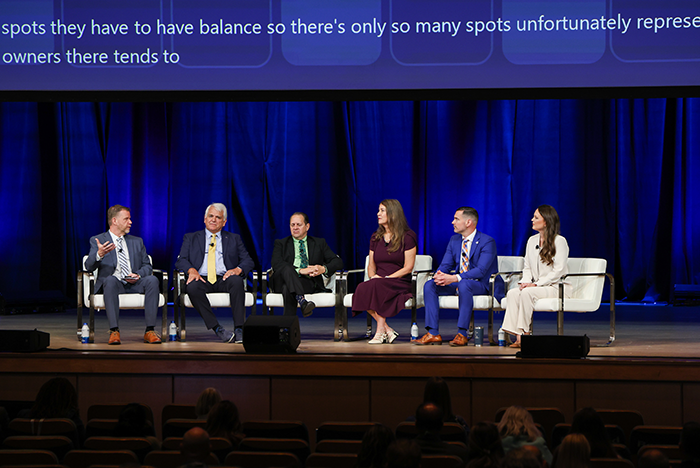
This year's "Just Ask ASHE" panel included ASHE staff and members who tackled audience questions on regulatory matters.
Image courtesy of ASHE
It featured Chad E. Beebe, AIA, CHFM, CFPS, CBO, FASHE, deputy executive director, ASHE Regulatory Affairs; Jonathan Flannery, MHSA, CHFM, FASHE, FACHE, senior associate director, ASHE Regulatory Affairs; Leah Hummel, AIA, CHFM, CHC, CHOP, SASHE, senior associate director, ASHE Regulatory Affairs; Jim Peterkin, PE, FASHE, LEED AP, principal, fire protection engineer and life safety consultant, at TLC Engineering Solutions; Krista Biason, PE, FASHE, national electrical practice leader at HGA Architects and Engineers; and Joshua Brackett, PE, CHFM, FASHE, JD candidate, system regulatory director of facilities operations at Banner Health.
Attendees were invited to ask questions about any codes and standards related to healthcare facilities.
This year’s top breakout sessions
In addition to the general sessions, a roster of 59 breakout sessions delved into every aspect of healthcare facilities management. Among the most popular of these were:
- "ASHRAE/ASHE 170 Update."
- "Building Trust Through Alignment in Health Care Facilities Management."
- "DNV Healthcare Update — Collaboration vs. Confrontation — Where Does it Say I Need to Do That?"
- "Designing for Recovery: Reducing Burnout Through Facility Leadership."
- "Navigating the 2026 FGI Codes: What’s New, What’s Gone and What You Need to Know."
Save the date for the next conference!
The Health Care Facilities Innovation Conference serves an array of healthcare physical environment professionals, including healthcare facilities managers, hospital and health system executive leaders, construction managers, safety professionals, technology and integration specialists, and facilities engineers at all career stages.
Save the date for the 2027 Health Care Facilities Innovation Conference taking place Aug. 1-4, 2027, in Denver.
Related Articles

Nuvolo launches regulatory compliance management to tie survey readiness directly to maintenance work
New capability maps regulatory standards to assets so healthcare organizations can build compliance evidence as work gets done.

Optimizing healthcare infrastructure through enterprise asset management
How Montefiore Einstein implemented a single source of truth for building spaces and infrastructure assets.

Security ecosystem helps manage risk
City of Hope partnered with Motorola Solutions to developed a layered security strategy for its 100-acre California campus.