

Electrical equipment advances for hospitals
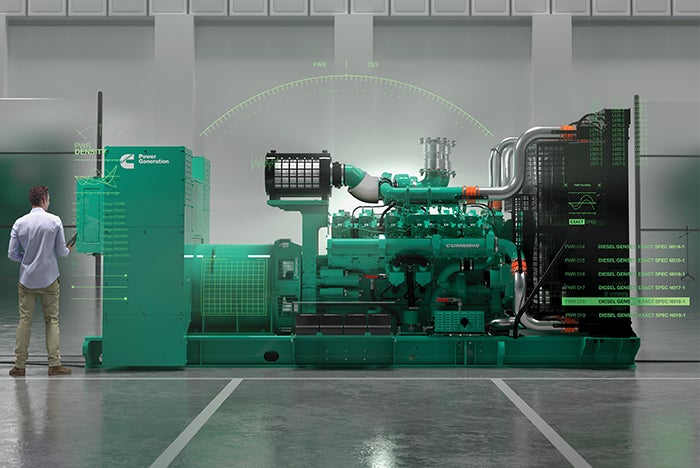
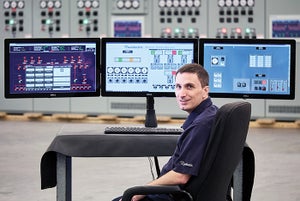
Image courtesy of Cummins Inc.
Manufacturers of generators and auxiliary equipment such as automatic transfer switches (ATSs) and uninterruptible power supplies (UPSs) have added more capabilities to their systems in recent years to help hospitals and other health care facilities.
Essential electrical systems have evolved from backup generators to advanced, integrated solutions. They combine UPSs, energy storage and power distribution to protect centralized information technology (IT) and distributed clinical areas while also providing consistent uptime and data integrity.
Among the big changes over the past few years has been the acceptance of on-board paralleling in large facilities. “Many hospitals are moving away from traditional paralleling switchgear and accepting on-board paralleling, which uses the generator controller as the brains of the system, offering the same capabilities as traditional switchgear but in a smaller package,” says Jack Kline, sales manager for engineered solutions at Rehlko Power Systems in Mosel, Wis.
Digital technologies also are playing a crucial role in modernizing hospital systems. New software platforms now enable real-time monitoring, predictive maintenance and optimization of on-site distributed energy. These tools help facilities managers identify issues early, streamline maintenance workflows and ensure compliance.
Finally, uninterrupted power for life safety has long meant reliance on diesel-only systems. In recent years, however, advances in standards and technologies have enabled safer, cleaner and more cost-effective alternatives.
By incorporating fuel cells and microgrids, hospitals can meet code requirements while cutting emissions, according to Frank DeLattre, president of the Americas for Musashi Energy Solutions in Battle Creek, Mich. “Tier 4 Final diesel generators, when used as backup, further reduce nitrogen oxides and particulate matter compared to older generator sets. In addition, battery storage provides instant ride-through, preventing power quality dips that could threaten sensitive medical equipment,” DeLattre says.
Control systems
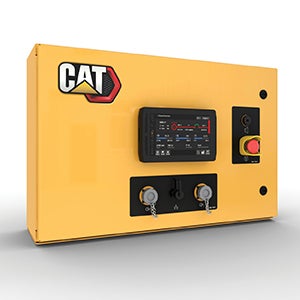
To help hospitals implement increasingly complex power solutions, Caterpillar Inc. in Irving, Texas, has introduced the Cat Energy Control System (ECS), a suite of integrated, scalable controllers that allow users to manage energy needs ranging from a single generator set to cohesive microgrid solutions across a site.
“These controllers utilize a simple, scalable architecture that enables facilities managers to layer additional functionality and serviceability as their power solutions evolve to meet their energy needs,” says Melissa Busen, vice president for Caterpillar’s electric power division.
“Cat ECS controllers also offer built-in plug-and-play features to facilitate the installation, commissioning and management of multiple power generation assets,” Busen says. “These control systems seamlessly integrate with sites using single or multiple power generation assets such as generator sets, battery energy storage and renewable energy sources. They also support power solution control capabilities, including generator set paralleling capability, combined heat and power (CHP) system management and full microgrid asset supervisory control.”
Generac Power Systems in Waukesha, Wis., recently rolled out the GeneracLink smart connectivity platform and made it standard on all its 200-kilowatt (kW) and larger generator sets. It remotely monitors generator status via mobile or web portal; receives real-time alerts for faults, maintenance needs and fuel levels; and views performance history.
“Facilities managers can track generator performance 24/7, helping ensure readiness during emergencies,” says Brad Meissner, Generac’s director of product management for industrial stationary generators. “Alerts for low fuel, maintenance needs or system faults allow for proactive intervention.”
Cummins Inc. in Columbus, Ind., offers PowerCommand controls embedded in generators, ATSs and master control systems to deliver core capabilities like automated startup, load sharing, fault protection and system coordination. “These control architectures scale across three levels — from individual component control to system-level coordination to advanced microgrid integration,” says Dean Gough, executive director of product and strategic marketing for Cummins Power Generation Americas.
Generator advances
Among generator introductions, Caterpillar has unveiled the Cat G3520K natural-gas generator set, which provides hospitals with a flexible power solution to reduce costs and improve resiliency. “Cat G3520K generators feature CHP or combined cooling, heat and power (CCHP) systems, enabling them to generate power for electrical loads while capturing waste heat that can be repurposed as thermal energy for heating, ventilating and cooling,” Busen says.
“While the combination of grid power and traditional boilers for thermal energy offers less than 50% energy efficiency, CHP and CCHP systems using the Cat G3520K Series can provide total energy efficiencies of up to 89.6%,” adds Busen. “They start more quickly, accept higher loads and ramp up to 100% load capacity faster than previous models.”
Cummins offers the Centum Series generator sets spanning 600 to 3,000 kW, which includes the new S17, QSK38, QSK50 and QSK78 engine platforms. The S17 platform represents a clean-sheet engine design that delivers high power density in a compact footprint from a 17L engine. “The S17 covers the power range of 600 kW to 1 megawatt (MW), allowing a single product to be specified for a wide spectrum of applications,” Gough says.
Rehlko Power Systems offers gas and diesel generators ranging from 15 to 4,000 kW. The KD series diesel generators feature power densities ranging from 700 to 4,000 kW. “They feature a common rail injection system, which optimizes fuel efficiency and reduces emissions,” Kline says. “The brushless alternator provides a sustained overcurrent capability of up to 300%, ensuring that downstream circuit breakers can trip without collapsing the alternator field. A cooling system also allows them to operate effectively in ambient temperatures up to 50 C.”
The KD Series’ ability to accept a full load in one step and its short-circuit capability ensure that power is seamlessly transferred to life-support systems, operating rooms and data management systems. “The long maintenance interval and modular design also help reduce operational costs and improve response time by simplifying service and parts management,” Kline adds.
Generac Power Systems recently introduced a line of diesel generators ranging from 2.25 to 3.25 MW, which are designed to support health care facilities of any size. They feature high-ambient cooling packages for top performance in demanding environments, as well as engines that provide optimal transient response, high-ambient temperature derate capability and low nitrogen oxide emissions.
A redundant starting system, Marathon alternators and configurable circuit breakers also are featured. “Generac and its dealers can provide packaging and aftertreatment, including enclosures, tanks and switchboards,” Meissner adds.
Transfer switches
For transfer switches, Eaton, whose U.S. headquarters is in Cleveland, makes a range of ATSs, including bypass isolation versions designed for health care applications. They feature dual-switching mechanisms: a primary switch for routine power distribution, and a secondary switch for redundancy and power during maintenance or repair. “This ensures that critical loads remain powered even when the primary switch is offline for servicing,” says Justin Carron, director of buildings and campuses at Eaton.
Cummins has introduced the PowerCommand X-Series automatic and non-automatic transfer switches and B-Series bypass-isolation transfer switches. They feature integral surge protection, downstream load control and power quality metering to support the complex backup power architectures common in hospitals. “Cummins’ blow-on mechanism architecture simplifies circuit breaker selective coordination, a key requirement for health care applications, ensuring compliance while enhancing system resilience and patient safety,” Gough says.
The latest ATSs from Schneider Electric’s ASCO Power Technologies in Florham Park, N.J., feature improved platform control, reliable transfer times and a variety of ratings and cycle counts, as well as additional communication options. “These upgrades deliver better reliability, maintainability and integration with hospital building systems and Schneider’s digital platforms,” says Andrew Carreno, national health care business development manager.
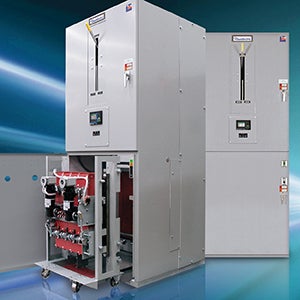
Russelectric, a Siemens business in Hingham, Mass., offers the RTS-30 Series of ATSs for hospitals and other critical facilities: a full line of 480-volt alternating current 30-cycle and three-cycle UL-compliant switches. They have been tested, listed and labeled for 30-cycle and three-cycle closing and withstand ratings under UL-1008, according to John Stark, product line manager. “The switches are ideal for basic transfer applications and for high-performance, inductive critical load transfer applications,” he says.
UPS innovations
Among UPS vendors, Eaton offers health care-grade UPS solutions that integrate built-in isolation transformer capabilities. This plays a critical role in ensuring electrical safety in medical environments by providing isolation between the input power source and the output. “This reduces leakage current — the small amount of unintended current that can escape from the device,” Carron says. “Reducing leakage current is essential for minimizing the risk of electrical shock, especially in sensitive patient care areas.”
ASCO Power Technologies’ sister company, APC, provides a wide range of UPSs, ranging from small rack-mounted units for IT closets to large facility-scale UPSs for imaging, surgical and laboratory environments. Key features include scalability, remote monitoring and integration with Schneider’s digital platform. “APC provides a complementary product to ASCO transfer switches that, together with integration into Schneider’s digital platforms, address hospital backup power needs,” Carreno says.
Musashi Energy Solutions recently introduced the ESS400 Hybrid SuperCapacitor-based energy storage system for integration with three-phase, double-conversion UPS systems for handling medium-to-large critical loads. This pairing delivers instant power backup and seamless transfer to on-site generators, meeting the power requirements of critical applications such as imaging suites, surgical theaters and data centers. “The instant ride-through power, clean conditioned output and resilient long-life storage eliminate the safety, maintenance and life cycle issues common to other systems,” DeLattre says.
Vertiv in Westerville, Ohio, offers the Vertiv Liebert APM2, a modular UPS designed for mission-critical applications. It utilizes three-level insulated-gate bipolar transistor topology and silicon carbide components to achieve conversion efficiency of up to 97.5%, resulting in lower energy costs and reduced environmental impact, according to Kyle Keeper, senior vice president of power management. “Key features include a scalable design, California Department of Health Care Access and Information compliance and a compact footprint,” says Keeper.
Flexible technology
“The future is moving toward greater digitalization and predictive analytics as well as microgrid capabilities,” Carreno predicts. “More hospitals will integrate renewables and battery storage with traditional generator-based emergency power systems while leveraging software to optimize testing, compliance and resiliency planning.”
Gough predicts that future solutions will lean further into flexibility. “Generators and storage assets will increasingly be designed for multiple configurations — whether in traditional standby, microgrid or hybrid applications, so that hospitals can put their assets to smarter use across a range of power needs,” he says.
PERFECT POWER
The Centum Series of generator sets spans 600 to 3,000 kilowatts and includes the S17, QSK38, QSK50 and QSK78 engine platforms. Cummins Inc.
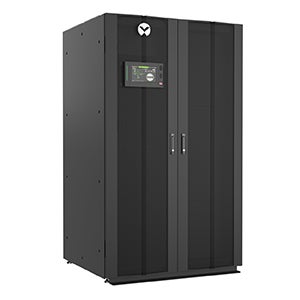
RELIABLE PERFORMER
The Liebert APM2 is a feature-rich, high-power density modular UPS that delivers double conversion efficiency of up to 97.5%. Vertiv
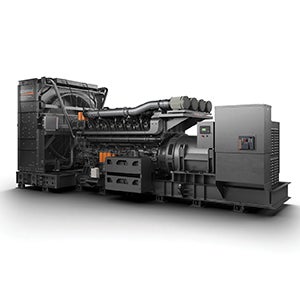
HEAVY DUTY
Large diesel generators ranging from 2.25 to 3.25 megawatts can support health care providers of any size. Generac Power Systems
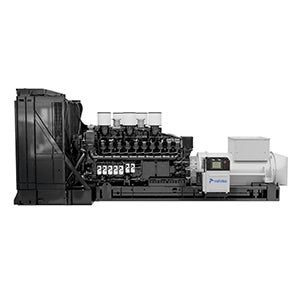
PLANT POWER
KD Series Generators meet industry testing and quality standards and are hydrotreated vegetable oil-ready. Rehlko Power Systems
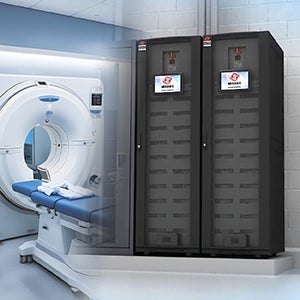
TECH PROTECTION
The ESS400 Hybrid SuperCapacitor System protects medical imaging equipment and information technology systems from costly power outages. Musashi Energy Solutions
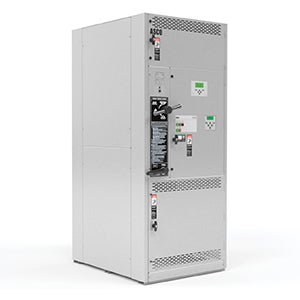
EASY UPKEEP
The 7000 Series bypass isolation transfer switch offers a secondary transfer mechanism that enables concurrent transfer switch maintenance without disrupting power to critical downstream loads. ASCO Power Technologies
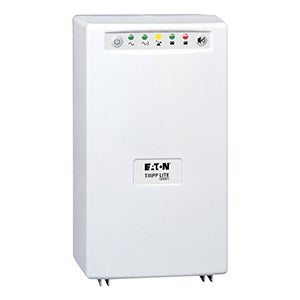
RELIABLE QUALITY
Hospital-grade uninterruptible power supply systems are engineered to safeguard critical medical equipment such as ventilators, defibrillators and infusion pumps from power outages, surges and electrical noise. Eaton
COMPLETE CONTROL
The Cat Energy Control System portfolio allows hospitals to manage energy needs ranging from a single generator set to full-site microgrid solutions linking multiple assets. Caterpillar Inc.
ATS OPTIONS
The RTS-30 Series automatic transfer switch is equipped with a bypass/isolation feature and has a 30-cycle rating. Russelectric
Neal Lorenzi is a Mundelein, Ill.-based contributor to Health Facilities Management.
Product inclusion in this article should not be construed as an endorsement by Health Facilities Management, ASHE or the American Hospital Association.
Related Articles
New solutions to power health care facilities
This month's featured power and electrical products range from transfer switches to power distribution units.
Solutions: Building controls, power and electrical, and flooring solutions
Building controls, power and electrical, and flooring solutions on our radar.
Emergency electrical systems add flexibility
Manufacturers introduce custom options and sustainable packages for emergency power supply needs.