

Students create cancer care center designs in just 48 hours
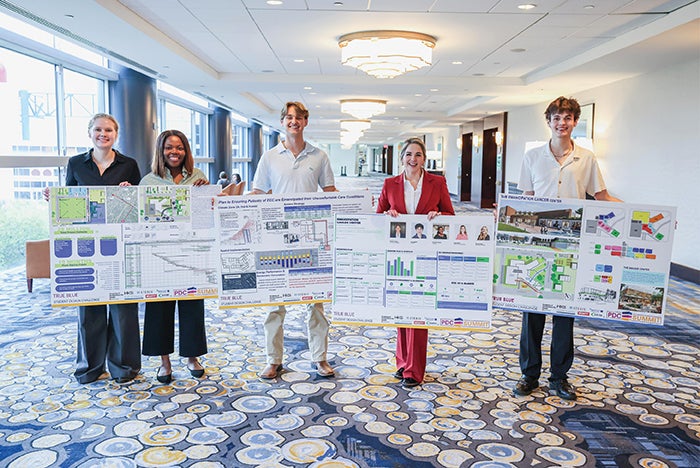
PDC Student Design Challenge participants showcase project boards from their winning project at the 2026 PDC Summit.
Image courtesy of ASHE
What happens when 20 students from five schools and four different disciplines walk into a room? That’s the question asked every year at the International Summit & Exhibition on Health Facility Planning, Design & Construction™.
The annual summit hosts the American Institute of Architects/Academy of Architecture for Health & American Society for Health Care Engineering PDC Student Design Challenge™. Now in its 11th year and growing in popularity, undergraduate and graduate students across architecture, construction, engineering and nursing disciplines are pushed to expand their creativity and deepen their experience in interdisciplinary collaboration through of-the-moment design charettes.
At the 2026 summit, which took place March 8-11, in Houston, students from the University of Utah College of Nursing in Salt Lake City; Kent (Ohio) State University College of Architecture and Environmental Design; Ball State University’s Department of Construction Management and Interior Design in Muncie, Ind.; University of Colorado Boulder College of Engineering and Applied Science; and the University of Texas at San Antonio School of Architecture + Planning were charged with creating a cancer care center and Maggie Centre in Houston’s Third Ward neighborhood, nicknamed the Tre. Students were given a tour of the location that served as the grounding inspiration for their designs. This year’s site ran along a street called Emancipation Avenue.
Hear from the students, mentors and chairs who participated in the 2026 AIA/AAH & ASHE PDC Student Design Challenge
Students are split into four teams and work on their designs for 48 hours. After two days of intensive collaboration, the teams present their work complete with architectural; construction; mechanical, electrical and plumbing; and clinical plans to a panel of judges, which selects a winning team and runner-up.
As the teams presented their designs, many recounted how their lives and the lives of loved ones have been impacted by cancer, promoting a deeper sense of responsibility to create facilities that would serve the particular needs of the Third Ward community.
“The Third Ward is in the middle of what we call a cancer care desert, meaning they have to drive or travel a long way in order to get their care,” says Cassi Martz, who served as the clinical expert on this year’s winning team, True Blue. “There are a lot of determinants of health that we considered when we were creating this project, but there’s also a very rich culture that we wanted to honor. In our design we focused on the patient, on the neighborhood and on the community.”
The team created The Emancipation Cancer Center and anchored all aspects of their project on the concept of emancipation — not only from cancer but also from fear, pain and fragmented care. Their front porch design, featuring lush greenery, water features and art honoring black history and creativity resonated with judges. The engineering systems were all planned with patient comfort in mind.
“My role as the mechanical engineer was to think about occupational comfort,” says Parker Cardozo, who served as the engineering expert on True Blue. “Too often, I think, those who are receiving infusions for many hours within a day have other things that interrupt their comfort, whether the facility is too cold or there is glare in their eyes. Maybe the heating, ventilating and air-conditioning system is too noisy. I worked with the architects and the nurse to [create systems] that are comfortable and would emancipate patients from every other stress besides the main one that they're focusing on.”
Another group, Team NCC, created the Neighborhood Cancer Care Center with the goal of creating a refreshing space in the middle of a medical desert.
“We conceived a design that would be an oasis by really leaning into biophilia and rooftop gardens,” says Garret Schwanke, who served as the clinical expert for Team NCC. “And for our programming, we focused on diagnostics to help accelerate treatment and also on operationalizing an infusion center.”
Teams also focused on ensuring the center could offer affordable care by producing efficient designs. For instance, Team Neighbors integrated energy-efficient systems at The Tre Cancer Center to lower operational costs and pour savings back into patient care. Another team, The Visionaries, produced the Jazz Note Cancer Collection, which incorporated outdoor pedestrian and communal spaces to meld the facility into the larger community.
“This was like a real-life project where you have different stakeholders and different people bringing in their ideas,” says Paula Ben-Smith, who is studying health care design at Kent State and served as one of two architects on True Blue. “It was a great opportunity to work with different people and incorporate their feedback in the spirit of teamwork and collaboration.”
One of the mottos oft repeated by the chairs and mentors who lead the annual event is that it’s “not my idea or your idea, but the best idea” that should win out.
“One of the most rewarding aspects is watching students ideate, iterate and work through complex project opportunities together,” says Gabe Auffant, AIA, ACHA, health care client leader at DLR Group and the outgoing chair of the PDC Student Design Challenge. “The most incredible moments happen when teams begin to recognize and lean into each other’s individual strengths in pursuit of the best possible solution.
“Personally, the experience has strengthened my own ability to listen, collaborate and create space for peers and clients to help shape and inform the design process,” he continues.
The importance of collaboration also left an impact on Kylie Woodward, the team clinical expert on The Visionaries.
“I learned personally that being a leader isn't about being the loudest one in the room or the one whose idea is picked,” Woodward says. “It's the one who can keep the group together and make sure that everyone feels listened to and heard. I walked away with so much leadership experience.”
Related Articles
Transforming facilities from retail to healthcare
Innovative architecture strategies to help developers and healthcare owners unlock the future of underperforming real estate.
Designing for safety in health care facilities
An overview of the International Association for Healthcare Security and Safety's design guidelines to protect patients, visitors and staff.
The blueprint for success in capital planning
The Center for Health Design’s Built Environment Network lays out the key steps of a holistic capital planning strategy.