

The blueprint for success in capital planning
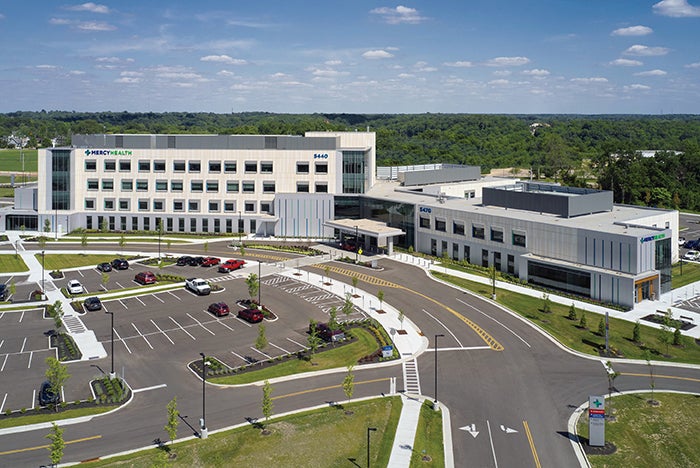
The ground-up, 54-bed Mercy Health Kings Mills Hospital acute care facility in Mason, Ohio, was developed within the fully integrated capital planning process of Bon Secours Mercy Health.
Image courtesy of Bon Secours Mercy Health
Restoring long-term financial sustainability amid mounting margin pressures, regulatory changes and rising expenses requires health care systems to identify opportunities to extract greater value from all available resources, especially capital.
The strategic deployment of capital can potentially enhance a system’s ability to navigate financial headwinds, promote growth and expansion, restore and modernize infrastructure, and rationalize facilities assets acquired through mergers and acquisitions.
However, the strategic deployment of capital mandates an orderly transition from strategy to execution. Capital planning is a bridge that can facilitate effective coordination of all activities, both capital program and project development.
High-performance health care systems effectively leverage capital planning as their blueprint for success.
Why it’s important
Capital planning is the disciplined process of allocating, evaluating and managing funds for major and minor projects, medical equipment, information technology (IT) and infrastructure updates.
It is essential because health care operates in a dynamic, high-risk environment where organizations must react efficiently, manage risk, use limited resources wisely and plan for long-term success.
Effective capital planning is done by aligning decisions with strategic vision and goals, prioritizing projects based on impact, using data-driven analysis and applying risk management strategies to ensure investments support sustainable, high-value care delivery.
Common challenges in capital planning include competing priorities, misalignment between strategy and capital decisions, financial uncertainty, aging assets, governance complexity and execution constraint.
Capital planning process
To organize and implement a thoughtful capital planning process, The Center for Health Design’s Built Environment Network (BEN) endeavored to initially define the key steps. Each step is critical on its own, and when applied together, they enable the organization to determine the highest and best use of capital dollars for years to come.
Click image to expand and view six steps for actualizing asset management.
Projects that are derived from this process require resilience to future scrutiny, thoughtfulness toward the strategic goals of the organization and the ability to stand steady in the headwinds of competition and uncertainty. Pulling from the experiences of BEN members and their successful results, the following steps and associated best practices enable achievement of the most reliable outcomes.
Strategy leads process
Health care leadership first must be deeply committed to strengthening and refining planning processes and fully support the operating model and the system’s evolving business needs.
Effective capital planning begins with the organization’s strategy leading the process. Strategy defines the “why” and determines the needs to be met. This, in turn, creates the “what, how, when and who” that is communicated to other team members.
Strategy facilitates the kick-off meetings based on the system’s organizational structure, which includes business unit leaders, finance, planning, design, construction and other necessary services.
As the health care landscape becomes increasingly dynamic and competitive, market forces are compelling systems to adopt a greater focus, accountability and differentiation in how they can pursue performance and growth.
At the same time, the volume and scope of capital requests continue to far exceed near-term capital capacity. This reality underscores the critical importance of disciplined prioritization, structured evaluation and thoughtful sequencing of proposed investments.
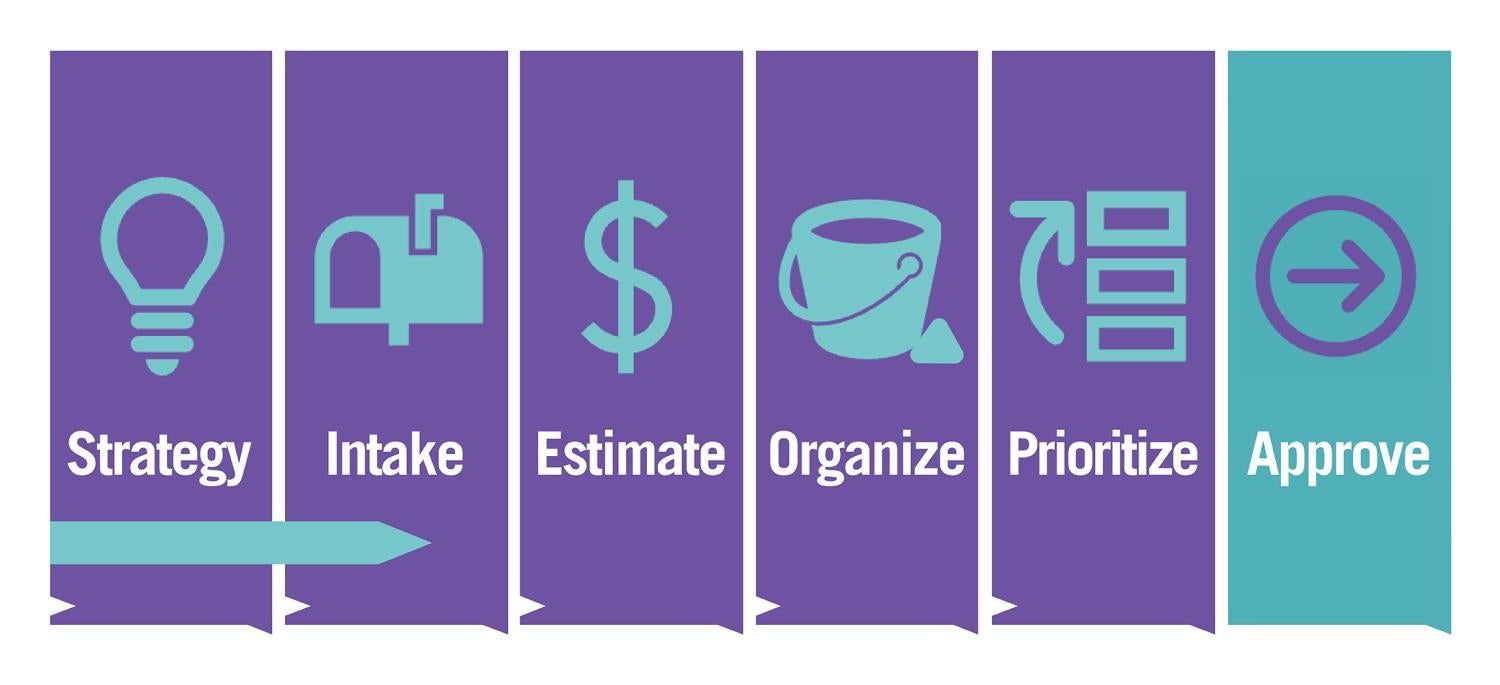
Click image to expand for an overview of the capital planning process.
Additionally, health care systems must place renewed emphasis on communication and expectation management throughout the planning, prioritization, review and approval cycles. By improving clarity, increasing transparency and fostering more proactive engagement with stakeholders, systems can build a shared understanding of priorities, decision drivers and timing considerations.
Yale New Haven (Conn.) Health augmented the senior vice president of corporate facilities and real estate role to include the title “chief systems design officer” to better orchestrate strategic planning functions that are necessary to translate strategy into execution.
Collectively, these efforts will position the health care system to make more informed, strategic and sustainable investment decisions that support its mission, strengthen its competitive standing and create long-term value for the communities it serves.
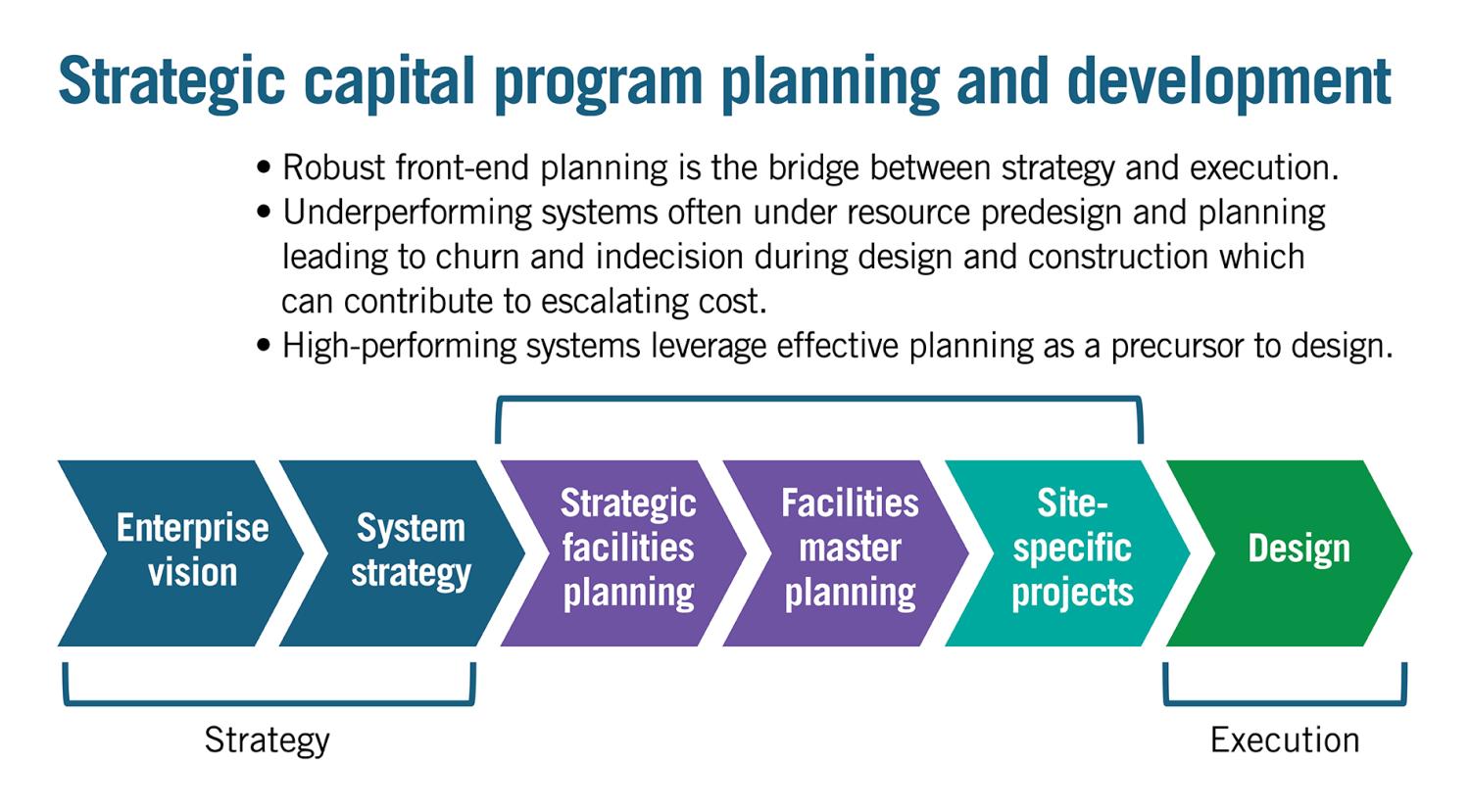
Strategic capital planning and development leverages robust front-end planning to assist in translating strategy into viable, actionable initiatives, fully aligned with business case objectives. An enterprise vision and system strategy that informs and aligns with strategic facilities planning creates a more integrated approach to identifying investments that will meaningfully strengthen market positions and advance long-term objectives.
Best-in-class capital programs ensure adequate resourcing of planning and programming functions to fully validate requirements that support preliminary business cases. As initiatives further evolve into concepts, facilities data and space requirements are synthesized to create viable capital projects. For renewal and modernization of existing facilities and infrastructure, inputs should include a capital maintenance plan informed by facilities condition assessments.
A formal intake process
The intake process is the formal entry point for all capital requests and is designed to ensure clarity, consistency and strategic alignment from the outset. In most health care systems, capital project requests are submitted by a business owner through a centralized software system and must be fully completed with key information, including scope, financial details, timing and a concise business case.
For example, early in the process at Corewell Health in Michigan, requests are reviewed for accuracy and visibility, and key partners — such as facilities, supply chain and project management — are notified. An executive sponsor and finance owner then qualify the request to confirm strategic alignment and relative priority. This qualification step is not a funding approval, but it affirms that the request is sufficiently defined and aligned to continue through the capital planning process.
Click image to expand and view examples of capital equipment requests.
Bon Secours Mercy Health, based in Cincinnati, is implementing a more-disciplined, annualized and transparent approach to capital planning that guides projects from early concept to approval. This will strengthen strategic alignment, improve decision quality and ensure responsible stewardship of resources. A key component of this alignment is the expanded use of the batch review process, which provides a consistent mechanism for assessing capital needs, prioritizing requests and allocating resources.
This begins with upfront ministry guidance that establishes capital capacity, long-range planning timelines, project “prescriptions” and priority project types. Investment proposals are collected through the annual batched intake, ensuring each opportunity is evaluated consistently and comparatively.
A multistep screening and prioritization process identifies the highest-value, most strategically aligned projects, while annual portfolio assessments, key performance indicators and retrospective reviews provide insight into performance. This enhanced structure enables a clearer connection among strategy, operational needs and capital deployment, ensuring that limited resources are directed toward the highest-value opportunities.
Estimating follows intake
In the short time that capital projects are received and evaluated, there simply is not enough time to fully design and estimate every potential project. Even a midsize health care organization could generate hundreds of requests in a single year. Each organization must have a systematic approach to quickly decipher the scope and assign an appropriate cost to begin the next step of organizing.
BEN believes that an in-house method based on metrics from similar scope and scale projects is most appropriate during this stage. Depending on the capabilities of the organization, this can be as simple as a single previous project comparison or as complex as software analyzing databases of numerous previous projects and industry cost benchmarks to issue an initial estimate.
If the estimate is too high, the project may be predestined to disapproval. If it is too low, the project may be prematurely approved. The objective is to have a reliable overall cost of the capital requests, knowing that some individual variation may occur but that the plan is achievable.
The project must be assigned not only a design and construction cost but also include the medical equipment, furniture and technology that will be needed. A uniform contingency and an escalation factor based on when the project might be implemented also is applied.
After subsequent organization and prioritization resulting in a high likelihood of approval, the project may be brought back to this step for additional review to assist with the scope and a more detailed cost estimate, often assisted by external design and construction professionals.
This can’t be achieved on every project, but it is wise for unique projects not previously attempted by the organization, complicated projects with a high degree of required infrastructure and large-scale projects in which a small percentage of variation could result in large swings of capital.
Considering all requests
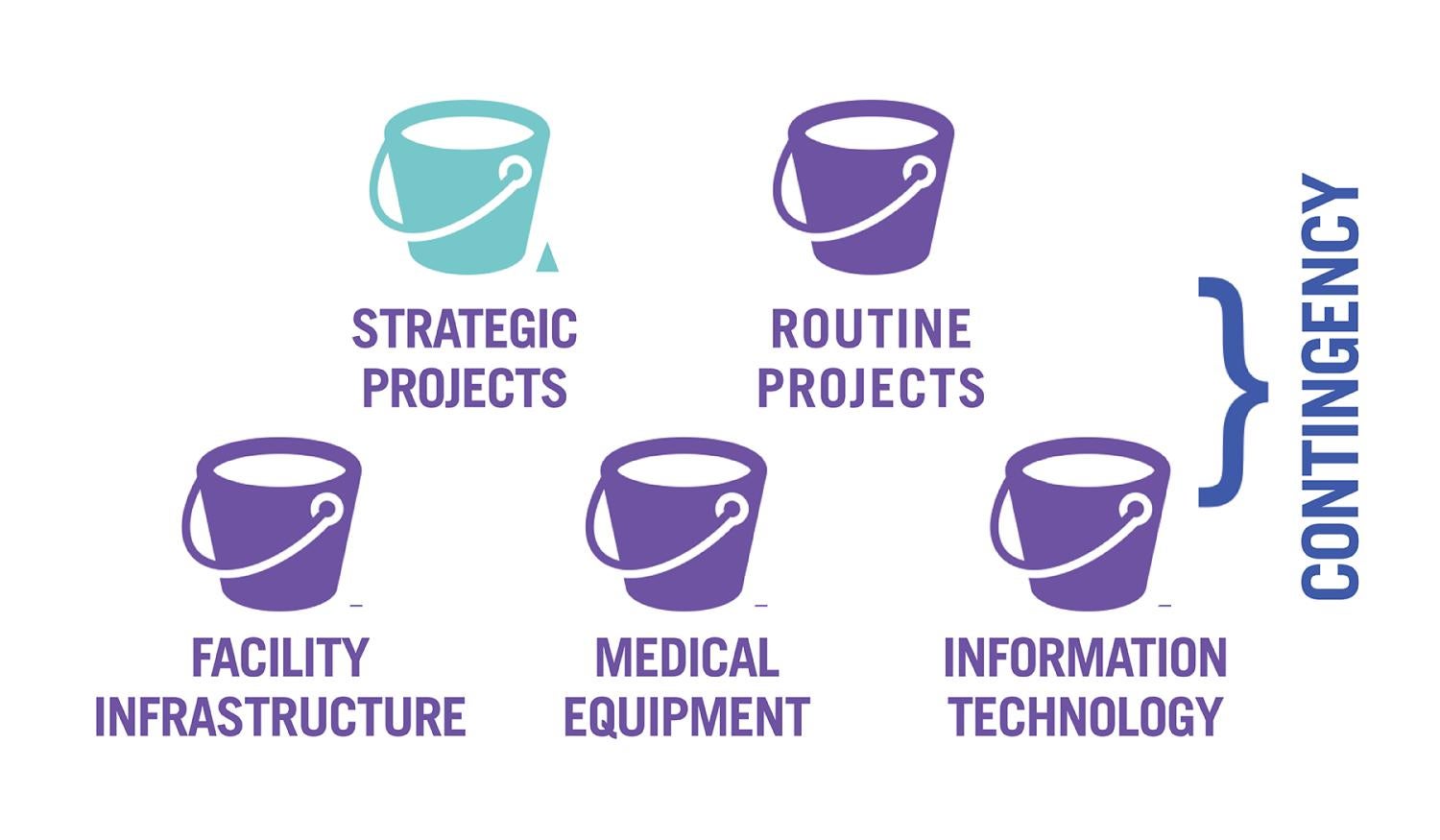
Although there is significant emphasis on facilities infrastructure and strategic projects related to growth and expansion in particular, other capital requirements associated with routine projects, medical equipment and IT can command equal or greater attention.
Advancing health care system vision and strategy in a coordinated manner requires a structured process for prioritizing investments while exercising discipline in execution of the enterprise capital program.
Return on investment may be relevant criteria for inclusion of a spectrum of projects, but it also is crucial to understand the importance of scoring to prioritize investments that address imperatives such as operational impact, brand, regulatory requirements, system reliability, modernization and technology refresh.
Prioritization and approval
Best practices in health care system capital prioritization and approval processes include strong governance and a structured operating system. At Corewell Health, once capital requests are qualified through intake, projects move into a structured prioritization process to ensure limited capital is allocated to the highest-value initiatives.
Requests are evaluated using a standardized set of criteria that considers strategic alignment, risk mitigation, operational impact, regulatory or safety needs, and financial return. Projects are organized into appropriate portfolios (e.g., ambulatory versus hospital) or capital pools (e.g., infrastructure versus strategic) and compared relative to one another to establish an enterprisewide priority order.
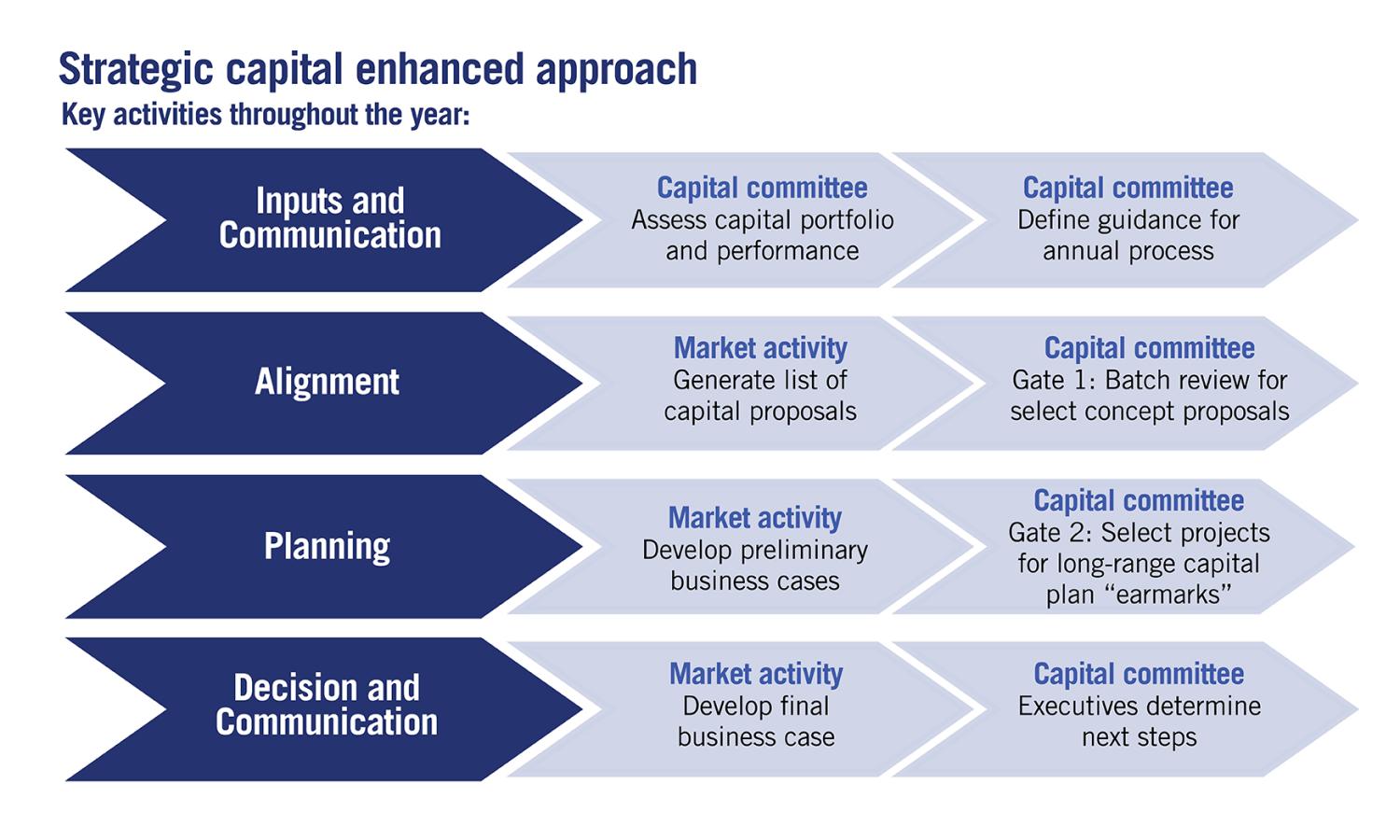
Click image to expand and view Bon Secours Mercy Health's capital planning process.
Prioritized projects then are advanced through a defined governance and approval structure, with recommendations reviewed by leadership committees and executive sponsors. Final approval decisions are made through established capital governance bodies to ensure alignment with organizational strategy, financial capacity and long-term capital plans. This process provides transparency, discipline and consistency in capital investment decisions across the organization.
At Bon Secours Mercy Health, a refined leadership model further supports alignment and clarity, including the following:
- The chief medical officer, chief strategy officer and chief financial officer jointly develop enterprise prescriptions and provide final review of all capital projects.
- Individual markets originate concepts and develop business cases for projects prioritized by each state and system leadership.
- State presidents conduct the initial screening and review of preliminary business cases. Market strategy partners work closely with these teams to support business case development and ensure strategic fit.
- The chief financial officer provides essential financial oversight by challenging assumptions, assisting with prioritization and approving financial pro formas.
To ensure consistency and disciplined execution, a standardized set of tools is used throughout the project life cycle. Annual education and communication help align expectations, followed by a concept proposal for initial screening, a preliminary business case to support prioritization and a final business case. Quarterly retrospective reviews by the capital committee ensure ongoing performance evaluation and reinforce continuous improvement. Together, these enhancements create a stronger, more reliable governance model that ensures every investment is strategically aligned, financially sound and positioned to deliver long-term value.
Pathway to alignment
Creating a blueprint for success through effective capital planning can be a pathway to strategically align capital spending and extract greater value from a health care system’s facilities and real estate portfolio. In today’s world, facilities sustainment often is treated as an afterthought wherein the infrastructure is drawn down like a battery that is never recharged.
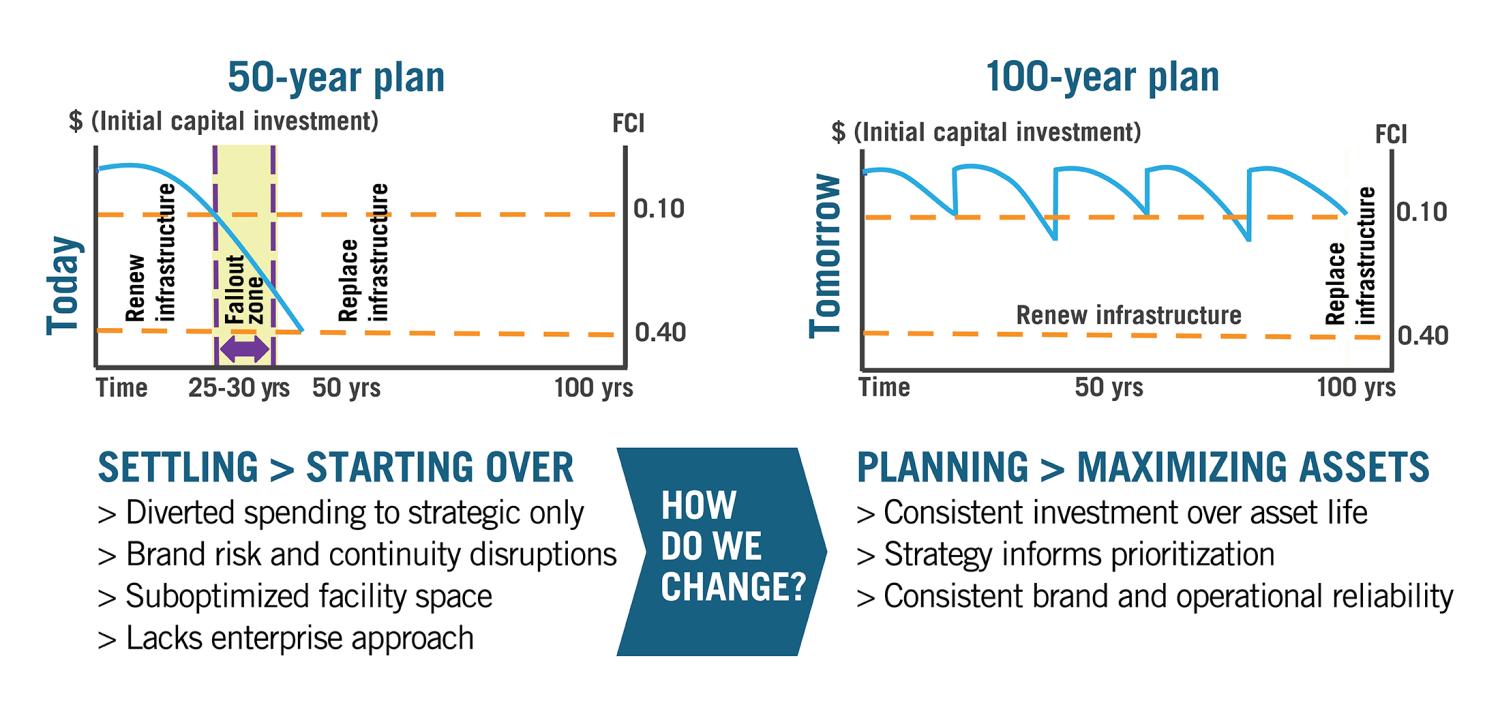
Click image to expand.
When treated primarily as an expense, infrastructure becomes an increasingly high-risk burden that inhibits optimized financial performance and agility in maneuvering through health care field headwinds. However, when treated as an asset, sustained through a comprehensive enterprise capital plan that balances all capital requirements, health care systems have a greater understanding of inherent risks and more effectively leverage near-term capital.
About the Built Environment Network
The Center for Health Design’s Built Environment Network (BEN) is a premier collegial network of executive-level facilities leaders and partners in the field who are dedicated to improving safety, quality, satisfaction and sustainability. Members have opportunities to learn and connect with their peers and colleagues by participating in open, strategic discussions that can define a direction for their own work as well as the future of the physical environment. BEN’s value proposition is to find a balance between members getting something that can be applied in their systems today while also contributing to the future of the field.
Members of BEN establish collegial relationships; participate in ongoing, open and collaborative conversations; have intimate access to colleagues via a shared interactive communication platform; and travel to member locations and other places of interest each year, often hosted by existing members. The network has both in-person and virtual meetings that provide exclusive opportunities for learning and collaboration.
A limited number of BEN memberships are available for senior-level executives from health care, design and solution provider organizations. To learn more, contact The Center for Health Design.
About this article
This is one of a series of articles published by Health Facilities Management in collaboration with The Center for Health Design. The authors are members of The Center’s Built Environment Network. To learn more about it and The Center’s other networks, visit The Center online.
Matthew D. Bode, AIA, is executive director of design and construction at Baptist Health in Jacksonville, Fla.; Chris Knueven is vice president of design and construction at Bon Secours Mercy Health, based in Cincinnati; Clayton Mitchell, PE, CEM, is senior vice president of corporate facilities and real estate and chief of systems design at Yale New Haven (Conn.) Health; and Kevin L. Vos is senior vice president of facilities and support services at Corewell Health in Michigan. They can be reached at matthew.bode@bmcjax.com, cknueven@bsmhealth.org, clayton.mitchell2@ynhh.org and kevin.vos@corewellhealth.org.
Related Articles

Making sense of health care sensory rooms
Research compiled in The Center for Health Design's Knowledge Repository documents outcomes related to multisensory care spaces.

Integrating robotics into inpatient facilities
Optimizing the design and layout of healthcare spaces to integrate autonomous mobile robots into daily operations.
Transforming facilities from retail to healthcare
Innovative architecture strategies to help developers and healthcare owners unlock the future of underperforming real estate.