

The 2026 FGI codes and FGI handbooks are now available
Editor's note: The article below appeared in the Spring 2026 issue of Health Facilities Management. It provides an overview of the development of the 2026 FGI codes and handbooks, including major changes and additions, related resources and education, which are now available. To learn more and to access the codes, visit FGI's website.
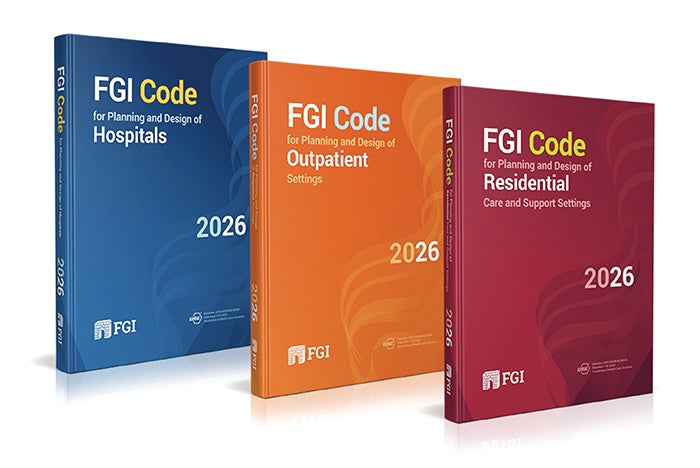
The FGI Codes present the minimum requirements intended for adoption and enforcement.
Image courtesy of FGI
When FGI began the four-year revision cycle that would produce the 2026 FGI Codes for Planning and Design, its Health Guidelines Revision Committee (HGRC) recognized that the new edition needed to go beyond refinements to existing requirements.
Alongside the committee’s ongoing work, FGI was confronting copyright infringement of its materials, an issue that underscored the need for a more sustainable and secure way to publish and distribute its content.
Rather than simply responding to the problem, FGI used the moment to take a broader view of how its documents were accessed, used and understood across the field.
Structural, philosophical, practical
Project teams using the FGI Guidelines had to navigate complex documents that created confusion by blending enforceable requirements with explanatory appendix text. Regulators, designers and owners were consulting the same resource for different purposes — and not always finding the clarity they needed.
At the same time, the landscape of care was shifting: behavioral health models were evolving, residential health care settings were adapting after the COVID-19 pandemic and outpatient networks were expanding, all as health care systems were being asked to deliver more services in a wider array of settings with fewer resources.
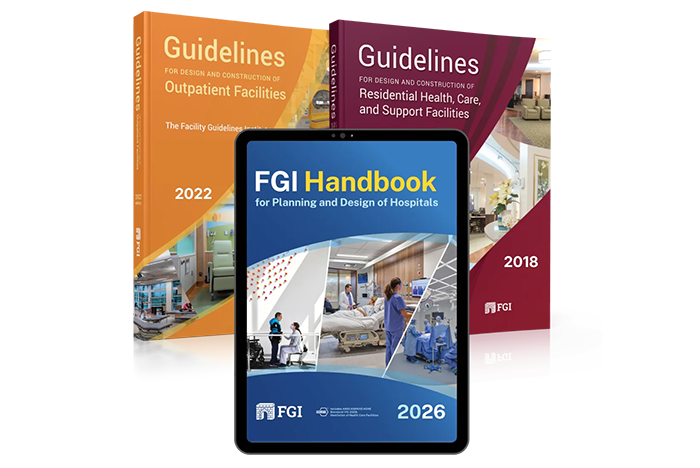
Against this backdrop, the HGRC guided the necessary revisions that allowed these 78-year-old documents to take a decisive step forward. For the 2026 edition, FGI has separated mandatory requirements from supplemental guidance and will soon publish three independent FGI Codes — for hospitals, outpatient settings, and residential care and support settings — supported by a new digital series of FGI Handbooks for Planning and Design. The FGI Codes present the minimum requirements intended for adoption and enforcement while the FGI Handbooks offer the context, illustrations, examples and explanations that help users understand the rationale behind those requirements.
The shift is structural, philosophical and practical. The FGI Codes are clear and easy to navigate, while the FGI Handbooks are dynamic, presenting guidance that can grow and evolve over time. And by offering a version of the FGI Codes as a free, searchable digital format, FGI is lowering barriers to access while reinforcing its role as the only authorized source for these accurate, up-to-date requirements.
Building consensus and code
The HGRC has always brought together a wide spectrum of expertise, and the 2026 cycle continued that tradition. Architects, engineers, clinicians, facilities leaders, regulators, researchers and advocates contributed their perspectives throughout the process, helping to ensure that revisions remain aligned with the needs of modern care environments.
Although the three FGI Codes were developed by separate groups, each working on a particular document, the work never occurred in isolation. Topic and task groups focused on specialized subjects such as behavioral and mental health, infection prevention, acoustics, plumbing, rural health and usability, and they shared their findings across the entire committee. For example, insights in the infection prevention group might apply across hospitals, outpatient settings, and residential care and support settings. The HGRC structure ensures that information is shared across document groups instead of being siloed.
Public participation, through submission of formal proposals and comments on the draft, is another essential layer in the process. Proposals went through several rounds of review; drafts were debated, rewritten and debated again, then tested for clarity and enforceability. While HGRC members may approach revisions with different priorities, the process relies on and underscores the belief that consensus produces more reliable and durable standards. The final language of the 2026 FGI Codes reflects this shared goal rather than the perspective of any single discipline or organization.
Organization and language
One of the most significant structural changes in the 2026 edition appears in Part 1, General Project Requirements. In previous editions, this section covered planning, design, construction and commissioning in a single chapter. Users often had to jump back and forth, searching for requirements that related to one another but lived in different parts of the text.
The HGRC steering committee stepped back and asked a deceptively simple question: What if the document followed the life of a project? That question led to a thoughtful reorganization into five sequential chapters: Introduction, Planning, Design, Construction and Commissioning. Requirements were not rewritten as part of this effort, only relocated so readers encounter information in the logical phasing of a design and construction project.
The change may seem logistical, but its impact is practical. Project teams now can progress through the FGI Codes with less friction, and early-career professionals — often tasked with researching code requirements — gain a straightforward path to understanding the material.
The glossary also received a comprehensive review. The steering committee evaluated every new, revised or deleted term to ensure accuracy, consistency and alignment with contemporary practice. Overlapping definitions were consolidated, outdated terminology was retired and language was aligned across all three FGI Codes. While the specifics vary, the overarching goal was straightforward: ensure that everyone who uses the FGI Codes is working from a shared vocabulary.
Key changes and impacts
The 2026 edition also introduces several new or revised requirements that respond directly to the challenges faced by health and residential care facilities. Although these changes span different settings, they share a common thread: each responds to a need emerging from real projects, real pressures and the evolving realities of care delivery.
- Incident command center. Consider the requirement for incident command centers in the FGI Hospital Code. During the COVID-19 pandemic, many health systems had to improvise operations hubs in spaces never intended to serve that function. The HGRC examined these experiences carefully. Facilities needed rooms that could shift quickly between everyday use and emergency operations, powered by essential electrical systems and equipped for sustained occupancy. By including clear requirements for such spaces, the 2026 edition turns lessons learned into lasting standards that support organizational readiness.
- Discharged patient lounge. The new requirement for discharged patient waiting lounges in hospitals reflects direct user input. Drafted early in the cycle and refined through discussion at the 2024 American Institute of Architects Academy of Architecture for Health/American College of Healthcare Architects’ Summer Leadership Summit, stakeholder feedback helped sharpen the operational focus of the final provisions. Many hospitals have already created dedicated lounges for patients who are medically cleared but waiting for transportation to reduce overcrowding, but until now, no minimum standards existed to guide their planning and design. These spaces help improve patient flow by allowing discharged patients to move from inpatient rooms sooner, freeing beds for new admissions. The new requirements formalize this emerging practice and establish clear expectations for lounges that provide a measure of protection for people while they wait for pickup.
Medical psychiatry unit. One of the most anticipated additions in the 2026 edition is the introduction of requirements for medical psychiatry patient care units, reflecting a growing need for settings that support patients with both behavioral health needs and acute medical conditions. These units support care for individuals who cannot be safely accommodated in a traditional medical-surgical bed or a behavioral health unit alone. HGRC members and external subject matter specialists noted that hospitals were already developing hybrid spaces to meet this need but without consistent guidance on design, safety or clinical support requirements.
The new provisions outline expectations for patient rooms, family-centered care and support spaces, while emphasizing the importance of a behavioral and mental health risk assessment to inform the functional program. Requirements also address the need for a dedicated calming room — an important feature for patients experiencing agitation or sensory overstimulation — and reinforce safety through environmental considerations tailored to dual-diagnosis populations. By defining minimum standards for these emerging units, the FGI Hospital Code provides hospitals with a clear framework for creating environments that support medical stability and behavioral health needs.
- Surfaces. The FGI Codes also strengthen expectations around infection prevention, especially in relation to cabinetry, casework and surfaces. The pandemic reaffirmed something infection preventionists have long known: even small design details can influence patient and staff safety. By standardizing language such as “able to be cleaned and disinfected” across the three documents and requiring enclosed or sloped surfaces above 68 inches in hospitals, the FGI Codes reduces ambiguity and sets clearer expectations for designers and facilities leaders working to limit pathogen transmission.
- Personal alarm for staff. Staff safety is a priority across all care environments, and the 2026 edition strengthens that focus with a new requirement for wearable duress alarm systems in hospital behavioral and mental health units. The provision emerged from discussions with front-line caregivers and leaders who emphasized the need for reliable, easy-to-use systems in high-risk settings. Devices must be simple to activate, capable of pinpointing the wearer’s location and connected to a continuously staffed monitoring point. The requirement underscores FGI’s broader commitment to environments that support the safety and well-being of those who provide care.
- Rural emergency hospitals. Some revisions respond to larger shifts in the health care landscape, including the introduction of rural emergency hospitals (REHs) as a new provider designation by the Centers for Medicare & Medicaid Services. The 2026 edition clarifies that FGI requirements for REHs are triggered only when the facility undertakes renovation or expansion. A simple change in licensure, such as from a critical access hospital or small hospital to an REH, does not require updates to the physical environment. This approach allows rural hospitals, central to care in many communities, to adjust their operations without incurring avoidable design obligations while still ensuring safe, compliant environments when construction does occur.
- Mobile units. Another example is the refinement of requirements for mobile units, which have become more common as health care systems bring diagnostic and specialty services closer to patients. The 2026 FGI Hospital and Outpatient Codes focus on mobile units that connect to host facilities and clarify expectations for documentation, onboard systems and integration with site infrastructure.
Outpatient settings. In the FGI Code for Planning and Design of Outpatient Settings, new chapters offer minimum standards for short-stay centers and sleep disorder centers. Both reflect how ambulatory care has grown into more specialized and sophisticated services. Short-stay centers are designed for patients who need monitoring or recovery for up to 72 hours; the FGI Outpatient Code outlines minimum requirements for room size, patient observation and support services. Sleep disorder centers, meanwhile, emphasize patient comfort as an essential part of accurate diagnostic testing, recognizing how environmental factors influence outcomes.
The FGI Outpatient Code also introduces more flexibility for clean supply storage. Facilities may now use a dedicated area when justified by a functional program and an infection control risk assessment. This option acknowledges the diversity of outpatient environments, from small clinics to large multi-specialty centers.
Behavioral health needs have similarly reshaped outpatient and emergency care. The relocation and expansion of requirements for behavioral health crisis centers provide clearer expectations for both standalone facilities and those embedded within freestanding emergency departments. The provisions address observation strategies, toilet room ratios and calming rooms for patient respite — elements critical to safe and supportive care during behavioral health emergencies.
Residential care and support settings. The FGI Residential Code also underwent a meaningful evolution. A task group of authorities having jurisdiction reviewed the entire document and proposed changes that would strengthen enforceability and ensure that minimums are measurable. A new chapter on residential behavioral and mental health treatment facilities defines requirements for environments serving individuals with dementia, neurocognitive conditions or neurodiverse needs — settings where safety and autonomy must exist in careful balance.
Other revisions in the FGI Residential Code emphasize the importance of social spaces. Expanded standards for dining and activity areas recognize the role of communal environments in resident quality of life. Requirements for minimum square footage, space for mobility and service devices, and natural light reflect contemporary understanding of how design shapes daily experience in long-term care.
Finally, in a continuation of previous documents, the 2026 FGI Codes for Planning and Design incorporates the 2025 edition of the American National Standards Institute/ASHRAE/American Society for Health Care Engineering’s Standard 170, Ventilation of Health Care Facilities, including all issued addenda.
A new approach
The 2026 FGI Codes for Planning and Design reflect a moment when both the field and the organization needed a new approach. As FGI strengthened its publishing model to protect the integrity of its content and ensure consistent access to validated requirements, the HGRC was simultaneously rethinking how the documents could better support rapidly changing health and residential care environments.
The result is a set of FGI Codes and FGI Handbooks that clarifies what is enforceable, explains the intent behind key provisions and makes it easier for users to find the information they need.
In many ways, the most consequential change in the 2026 FGI Codes is not any single new requirement but the collective impact of a more navigable, transparent and resilient set of standards. They capture the lessons of recent years while preparing for the demands ahead, reinforcing FGI’s commitment to supporting safe, effective environments for health and residential care through documents that evolve alongside practice.
Related article // FGI expands into education
Launched by FGI in late 2025, FGI University is a new initiative designed to make education as accessible as the FGI Codes themselves. As planning and design become more complex, many professionals need ongoing training, not only to stay current with formal requirements but also to understand the reasoning behind them. FGI University was created to meet that need.
FGI University offers courses on updates in each edition of the FGI Codes/Guidelines, a preview of a groundbreaking tool for determining clinical room needs, foundational training in acoustics for health and residential care environments, and deeper insight into new space types introduced in the 2026 FGI Codes. Each course is developed and presented by subject matter experts and members of the HGRC, ensuring that content is accurate, practical and aligned with the FGI Codes. Participants can — at their own pace — explore requirements, view examples with real-world implementation, learn strategies for application and understand the intent behind code requirements — resources that are valuable to professionals at every level. Many offerings also qualify for continuing education credits.
By expanding access to expert guidance, FGI University helps ensure that every project — large or small, rural or urban — benefits from a shared understanding of what quality environments require. To learn more, access FGIUniversity.org.
About this article
This article is published by Health Facilities Management in collaboration with FGI. To learn more, access fgiguidelines.org.
Barbara Stretchberry is FGI’s managing editor. She can be reached at barbara@fgiguidelines.org.
Related Articles

Making sense of health care sensory rooms
Research compiled in The Center for Health Design's Knowledge Repository documents outcomes related to multisensory care spaces.

Integrating robotics into inpatient facilities
Optimizing the design and layout of healthcare spaces to integrate autonomous mobile robots into daily operations.
Transforming facilities from retail to healthcare
Innovative architecture strategies to help developers and healthcare owners unlock the future of underperforming real estate.